For 70 of the 220 years since the Supreme Court asserted its jurisdiction over American law – so nearly one-third of this history – there has been a reliable and consistent platform of discourse about the court (and many other subjects): "The Open Mind," the longest-running series in PBS history and one that my grandfather founded in 1956 and that I have hosted since his death in 2013. From deliberations about segregation and discrimination to litigation surrounding monopolies and anti-trust, privacy in America and the Patriot Act, and blocking citizen accounts on Twitter/X, “The Open Mind” – like SCOTUSblog – has been studiously attentive to Supreme Court opinions, dissents, and what, exactly, this all means for our republic. Along the way, our guests have included a who’s who in constitutional theater, including Justice Stephen Breyer, Judge Robert Bork, Circuit Judges Robert Katzmann and Richard Posner, Supreme Court advocates Floyd Abrams and Neal Katyal, scholars Derrick Bell and Martha Minow, a shaper of contemporary Supreme Court reporting Anthony Lewis, and a new generation of legal academics like law professors Justin Driver, Leah Litman, and Carissa Byrne Hessick.
On Wednesday, I will have SCOTUSblog’s founder Amy Howe and executive editor Zachary Shemtob as my guests to discuss the Supreme Court’s 6-3 ideological majority, whether the justices would ever be open to the possibility of reform, transparent ethics standards, the possibility of expansion, and much more.
Before then, however, I wanted to share several things that I’ve learned from being part of a series that has spent seven decades covering the court.
First is how gradually, and then all at once, history can change on the court. When “The Open Mind” was first broadcast, Chief Justice Earl Warren had headed the court for only three years and would come to herald an unprecedented progressive era on it. This changed with the Burger era, and then dramatically so with the Rehnquist and Roberts courts. Once on the margins of Supreme Court jurisprudence, originalism, in particular, has sought to halt the emerging practice of Living Constitutionalism. In episodes over the past quarter of a century, viewers can see that pendulum swing – at first incremental and then rapid-fire – from a liberal to conservative majority. Yet this was also contingent. Had Hillary Clinton won both the Electoral College and popular vote in 2026, we might be witnessing a liberal era on the court rather than a conservative super-majority.
Another enduring subject is cameras in the courtroom. This was one of my grandfather’s favorite subjects to explore. He saw this discussion as essential to Americans' engagement in the branch of government that was becoming increasingly pivotal in deciding the future of their lives. While today there is live audio of oral arguments, I wonder if the Supreme Court had also opened its doors to cameras – as a civic counterpoint to the sensationalistic Court TV coverage – more citizens would have taken sustained interest in the court’s role in our republic. And it is now natural to wonder whether that time may have passed: In today’s era of social media, clips are all too often deployed as ammunition to bolster one side rather than to find common ground.
This period also corresponded with the increasingly punitive prosecutions and imprisonment of the American people – which has made the United States per capita the most incarcerated nation in the developed world. Although the court has issued surprisingly few decisions in this regard, the fact that one-third of American families have a loved one impacted in the justice system has significant implications for both federal and state law. In a series of episodes featuring national leaders like Equal Justice Initiative founder Bryan Stevenson as well as local and state reformers, we explored facets of the contemporary justice reform. Our subjects included the death penalty, life sentences, and probation and parole – some areas of the carceral state in which the court has actually spoken.
Finally, and returning to my first point regarding historical shifts on the court, one of the things that has fascinated me most – and still does not get enough discussion – is that the composition of the court, and, indeed, the fate of our country, is determined by the status of nine individuals’ health (namely, who dies, and when, and who is president and the senate majority leader at any given moment). Even if one believes life tenure for judges is a good thing, today’s model feels more like royal inheritance than republicanism, especially considering that three of the newest justices were appointed by President Donald Trump in his first term, when he lost the nation’s popular vote.
There is, of course, far more to say about the Supreme Court. But I’ll end with an anecdote. In the 1990s, I was not more than 10 years old when my grandfather took me on my first trip to Washington, D.C. to see the memorials and monuments in all their glory. He also arranged a greeting with Justice Breyer, whom he had interviewed as the chief judge of his circuit court before his Supreme Court nomination.
After graciously receiving us in his chambers, Breyer sent me off with an autographed pocket U.S. Constitution. I thanked him and probed innocently: “But, Mr. Justice, don’t you need this?” (Although he didn’t respond at the time, I was later told he found this quite amusing – Breyer is well-known for his “professorial” sense of humor.)
In truth, we all should be armed with this document and debate often its meaning – clichéd as this may sound, it remains the bedrock of our founding and evolving life as a nation.
]]>This is not the first proposal to rearrange the chief justice’s duties. Indeed, the office has evolved haphazardly within its meager constitutional moorings; the only mention of it in the Constitution is that the chief justice preside at presidential impeachment trials.
In the beginning
In 1790, George Washington told the Marquis de Lafayette that “[b]y having Mr. Jefferson at the head of the department of state, Mr. Jay of the judiciary, Hamilton of the treasury, and Knox of that of war, I feel myself supported by able coadjutors, who harmonize extremely well together.” Washington sought no control over judicial decisions but saw the chief justice – John Jay at the time – as an executive branch advisor, reflecting English practice. In that vein, Washington turned to Jay for all types of help. When preparing a state-of-the-union message, for example, he sought “every matter which may occur to the heads of the Departments” and thus asked Jay for “anything in the judiciary line, anything of a more general nature.”
Congress assigned the chief justice other high visibility executive branch tasks, making what Constitutional Convention delegate George Mason called “further use . . . of the Judges.” The chief justice became an administrator of the sinking fund to retire the Revolutionary War debt. Additionally, to protect the integrity of the nation’s coins, Congress directed an annual assay “under the inspection of the Chief Justice” and several others.
Gradually, Jay and his colleagues took exception to these ex officio side jobs. Jay skipped a sinking fund meeting because he saw his “[d]uty to attend the Courts as being in point of legal Obligation primary, and to attend the Trustees as secondary.” He also led the justices in declining Washington’s invitation to become on-tap legal advisors. Today, the only major vestige of the early republic’s efforts to use the chief justice outside the judiciary is as an ex officio regent of the Smithsonian institution and related bodies, a role dating to 1846.
That said, presidents and others have occasionally turned to justices for non-ex officio tasks. For instance, Washington designated Jay – an experienced diplomat – to be an “envoy extraordinary” to Great Britain. More recently, President Harry Truman assigned Justice Robert Jackson as chief Nuremberg prosecutor, and President Lyndon Johnson implored a reluctant Chief Justice Earl Warren to chair the Kennedy assassination commission because, Warren recalled, Johnson “thought no less a personage than the Chief Justice of the United States. . . should head it.”
These days, such assignments are largely relics of the past.
The chief justice’s roles
Currently, the chief justice’s only major role beyond the Supreme Court (and the Smithsonian) is what the judiciary’s initial long-range plan called “the head of the federal judicial system . . . in matters of judicial administration.” It is a position with three components: judicial administrator, judicial spokesperson, and judge designator.
First, chief justices oversee the administration of a small federal agency – the federal judiciary. He does so, not by an all-inclusive congressional designation, but because by statute he presides over the U.S. Judicial Conference – 26 judges serving ex officio or by election. By tradition, the chief justice appoints its now-25 committees, which do much of the conference’s work. He also appoints the Director of the Administrative Office of U.S. Courts and chairs the Federal Judicial Center board.
The judiciary is tiny. (Its $10 billion budget is less than two-tenths of one percent of total federal spending, and its 30,000 employees pale in comparison to the Justice Department’s 115,000.) But its administration is not a simple matter. The Administrative Office exercises pages of financial, personnel, automation, and security duties under the conference’s supervision. These and other matters in the conference’s remit have recently blossomed into controversies over judges’ workplace conduct, oversight of financial disclosures, judges’ physical security, and administration of the judicial discipline machinery (e.g., here and here). Amendments to the courts’ procedure and evidence rules and even some Federal Judicial Center educational programs make news. The chief justice is ultimately responsible for these activities even if he isn’t personally involved in most of them and goes unmentioned in news reports.
Second, chief justices are the federal judiciary’s major spokesperson and in that role promote policies they regard as significant, often in conference and lecture settings. The press covers this doggedly, and the chief provides a year-end report (since the Burger era) on the status of the judiciary.
Third, chief justices designate judges for the Foreign Intelligence Surveillance Court, which entertains government applications to conduct national security investigations, as well as on the Judicial Panel on Multi-District Litigation, which assigns related cases in multiple districts to a single district for pretrial procedures.
How did we get here?
Ultimately, these roles are the result of incremental adaptations, not some grand design. Chief Justice William Howard Taft persuaded Congress to create the Judicial Conference’s forerunner in 1922. Comprising nine senior appellate judges and chaired by the chief justice, it coordinated the chief justice’s temporary assignment of judges to other courts. The chief justice gained more authority in 1939 when Congress revised and enacted a remnant of President Franklin Roosevelt’s Judicial Procedures Reform Bill of 1937 (which also included his “court-packing” plan) by transferring the Justice Department’s court administration functions to the new Administrative Office to function under the conference’s supervision. The chief justice’s sole authority to appoint conference committees then emerged without much consideration of other approaches.
Likewise, when Congress created the FISA court in 1978, vesting appointments in the chief justice created “only a small amount of debate.” “[H]istorical practice” (namely, chief justice appointments since 1971 to a temporary wage-and-price controls court) was said to have “served as a persuasive justification.”
Rethinking the office
In 1978, Chief Justice Warren Burger warned that the duties of the office were almost overwhelming. To ease the burdens, he floated the idea of a statutory “circuit justice for administration,” in which sitting judges could serve temporarily. This idea remained under discussion in the judiciary as late as 1995.
Others raised different concerns following the courts’ considerable growth during the Burger and Rehnquist eras. Commentators agreed that the chief justice had too much work, but further argued that because that work has policy implications, vesting it in one person with unlimited tenure is undemocratic. Such commentators asked, and continue to ask, whether chief justice appointments to the conference committee and the FISA court reflect systematic preferences for judges likely to agree with the chief justice’s views.
Alternative approaches fall into two broad categories: chief justice term limits and statutory reassignment (or chief justice delegation) of some or all duties to other justices or judges.
Term limiting the chief justice is consistent with how Congress in 1982 sought turnover and stability in the positions of the chief circuit and district judge – designation by age and seniority, an age cap of 70, and seven-year maximum terms, thus making it likely that judges with different approaches to the job, and appointees of presidents of both parties, rotate in and out of the position. As to chief justices, however, who have more administrative clout than chief district and circuit judges, the last year in which a Democratic appointee served in that office was 1953 (the year Chief Justice Fred Vinson died).
Delegating the chief justices’ duties to lower court judges is hardly a new idea. Since 1945, the Conference’s Committee on Intercircuit Assignments and its forerunners have had the lead role in implementing the chief justice’s statutory authority to approve voluntary intercircuit assignments of judges to other courts, a slimmed-down version of the conference’s original task.
Upon becoming chief justice in 1986, William Rehnquist launched a study of the entire committee system, which recommended “strengthening the authority of the Executive Committee to deal with internal and external Conference business [and] allow[ing] the Chief Justice to delegate some of his Conference duties to another Conference member.” The executive committee is now a powerful and constant overseer of the conference’s activities, no doubt taking actions that might otherwise reach the chief justice’s desk.
These delegations have provided greater administrative efficiency but not necessarily the policy diversity that advocates seek. Given the deference within the judicial hierarchy, as long as the chief justice is “the head of the federal judicial system,” other judges will likely try to administer consistent with the chief justice’s perceived preferences. And there is value, whatever duties are delegated, for the chief justice to retain that role. (Whatever the force of Chief Justice John Roberts’ admonitions to stop personal attacks on judges, they have more strength than if issued by a lower court judge who by rotation was presiding over the Judicial Conference.)
Delegation to other justices would lessen the likelihood of deference but enhance the likelihood of resistance. Other justices might like a turn at presiding at oral argument but not at overseeing federal judicial administration, which Roberts acknowledged in 2023 is “an acquired taste.” Indeed, when in 1939 Congress deliberated who would supervise the new Administrative Office, the justices were cool to their possible involvement. “[T]he duty of the Court,” said Justice Louis Brandeis, was “to adjudicate, not administer.” Even at that, the 1939 Congress put the Administrative Office under the conference’s supervision but told the entire court to appoint its director. Only in 1990 did it transfer that formal authority to the chief justice, the only justice with lower-court judicial administration duties. No associate justice, to my knowledge, contested the reassignment.
In the final analysis, there is something of a quandary. It’s no disrespect to any recent chief justice to worry that their powerful, life-tenured executive position sits uneasily within the principles of democratic government. But, as is often the case, it’s not clear if or how well alternative approaches would work.
]]>Article I. All men are born free and equal, and have certain natural, essential, and unalienable rights; among which may be reckoned the right of enjoying and defending their lives and liberties; that of acquiring, possessing, and protecting property; in fine, that of seeking and obtaining their safety and happiness.
In my initial articles, I showed that the “born free and equal” idea is deeply rooted in American history and tradition, and applied this clause within the context of same-sex marriage and eugenics laws, among other major Supreme Court precedents.
Today, I want to turn to the court’s incorporation of the first eight amendments of the Bill of Rights and argue that they should all be fully incorporated – that is, applied to the states – which the Supreme Court has not yet done. I will also argue that the court in Kian v. Florida, which it is hearing this coming term, should hold that state criminal defendants are entitled to a 12-person criminal jury trial and not a six-person one, as prior precedent wrongly allows for. Likewise, the court should overturn its 1916 decision in Minneapolis & St. Louis R. Co. v. Bombolis and incorporate the Seventh Amendment’s right to a civil jury trial to apply against the states.
***
In 2010’s McDonald v. City of Chicago, the court held the Second Amendment right to own a gun in one’s home was deeply rooted in American history and tradition, thus meriting incorporation. Specifically, the court correctly reasoned that because 22 out of 37 states in 1868 and 59% of the states in 1868 (when the 14th Amendment was ratified) had Second Amendment analogues, the right to own a gun in one’s home was an enduring one.
Based on McDonald, I use 22 states as a benchmark for incorporation and show that 22 or more states in 1868 recognized an analogue to almost all of the rights in the federal bill of rights (these numbers are further detailed here).
- The entire First Amendment was deeply rooted in American history and tradition in 1868. As of that year, 27 out of 37 states forbade an establishment of religion in their state bills of rights and all 37 states forbade state laws prohibiting the free exercise of religion; 32 of 37 states forbade laws abridging freedom of speech, and all 37 forbade laws abridging freedom of the press; 34 states out 37 forbade limits on the right to petition the government for the redress of grievances; and 36 out of 37 guaranteed the right to assemble.
- The Second Amendment right to keep and bear arms, as mentioned above, was protected by 22 out of 37 state bills of rights in 1868.
- The Third Amendment right not to have soldiers quartered in one’s house was protected by 26 out of 37 states in 1868.
- The Fourth Amendment protection from unreasonable searches and seizures was protected by 36 out of 37 states in 1868, and 36 out 37 states in 1868 also had rules, as the Fourth Amendment does, as to the lawful issuance of warrants.
- The Fifth Amendment protection against double jeopardy was recognized by 31 out of 37 states in 1868; 34 out of 37 states in 1868 guaranteed a right against self-incrimination; 32 out of 37 states guaranteed a right to confront the witnesses against you in 1868; 35 out of 37 states had due process of law clauses; and 33 out 37 state bills of rights had taking clause analogues in 1868.
- The Sixth Amendment right to jury trial in criminal cases was protected in all 37 states in 1868.
- The Seventh Amendment right to a jury trial in civil cases was protected in 1868 by 36 out of 37 state bills of rights.
- And the Eighth Amendment protection against excessive bail was protected in 36 of 37 state bills of rights in 1868; the protection against excessive fines existed in 35 out of 37 states as of that year; and the protection from cruel and unusual punishments was recognized in 34 out of 37 states.
Given this, it is clear as a bell that the entire federal Bill of Rights – except for the right to indictment by a grand jury – was deeply rooted in American history and tradition, as expressed in the state bills of rights in 1868 when the 14th Amendment was ratified.
The legislative history of the 14th Amendment (as argued by fellow SCOTUSblog columnist Akhil Amar) also supports complete incorporation of the Bill of Rights. Senator Jacob Howard, who reported the 14th Amendment’s text to the Senate on behalf of the Joint Committee on Reconstruction said the following:
It would be a curious question to solve what are the privileges and immunities of citizens of each of the States in the several States. I do not propose to go at any length into that question at this time. … But we may gather some intimation of what probably will be the opinion of the judiciary by returning to a case adjudged many years ago in one of the circuit courts of the United States by Judge Bushrod Washington of the Supreme Court; and I will trouble the Senate but for a moment by reading what the very learned and excellent judge says about these privileges and immunities of the citizens of each State in the several States. It is the case of Corfield v. Coryell.
Judge Washington says: …
Such is the character of the privileges and immunities spoken of in the section of the fourth article of the Constitution. To these privileges and immunities, whatever they may be—for they are not and cannot be fully defined in their entire extent and precise nature—to these should be added the personal rights guaranteed and secured by the first eight amendments of the Constitution …
It is high time for the court to also adopt this understanding.
***
This all brings us to Kian v. Florida. In the 1970 case of Williams v. Florida, the Supreme Court allowed for six-person rather than 12-person juries in state criminal cases. I think the word “jury” is a legal term of art that means 12 people by definition – and this was historically understood as such. Thus, Noah Webster’s 1828 online Dictionary of American English, which the ratifiers of the 14th Amendment would have used, defines “jury” as follows:
JU'RY, noun [Latin juro, to swear.] A number of freeholders, selected in the manner prescribed by law, empaneled and sworn to inquire into and try any matter of fact, and to declare the truth on the evidence given them in the case. Grand juries consist usually of twenty four freeholders at least, and are summoned to try matters alleged in indictments. Petty juries, consisting usually of twelve men, attend courts to try matters of fact in civil causes, and to decide both the law and the fact in criminal prosecutions. The decision of a petty jury is called a verdict.
Samuel Johnson’s Online Dictionary of English defines “jury” in the same way:
JU’RY, n.s. [jurata, Lat,jure, Fr.] Jury, a company of men, as twenty-four, or twelve, sworn to deliver a truth upon such evidence as shall be delivered them touching the matter in question.
The ratifiers of the federal Bill of Rights would then have understood that a jury of 24 persons was required to indict a person, while a jury of 12 persons, not six, was required by the Sixth Amendment to try a person. (Amar also explains this in his splendid amicus brief in Kian v. Flordia.)
Similarly, a jury of 12 would have been required in all civil cases at common law under the Seventh Amendment. As Justice Neil Gorsuch said in a statement respecting the denial of review in Thomas v. Humboldt County, California:
The right to a civil jury trial remained so deeply rooted that perhaps 97% of Americans at the time lived in States that guaranteed the right. See S. Calabresi & S. Agudo, Individual Rights Under State Constitutions When the Fourteenth Amendment Was Ratified in 1868, 87 Texas L. Rev. 7, 116 (2008). In fact, the civil jury trial right may have enjoyed even more robust protection in American States than various other rights this Court has deemed fit for incorporation. See Timbs, 586 U. S., at 152 (35 out of 37 States expressly forbade excessive fines at the time of the Fourteenth Amendment’s adoption); McDonald, 561 U. S., at 777 (22 of the 37 States “explicitly protected the right to keep and bear arms” in 1868).
Justice Gorsuch is correct. The Seventh Amendment should be incorporated to apply against the states through the 14th Amendment. In a properly presented case, the Supreme Court should grant review on this question and, as with regard to juries fewer than 12 persons, correct this historical injustice.
]]>Forty-five years ago today, the Senate unanimously confirmed Sandra Day O’Connor’s appointment to the Supreme Court.
At the Court
The Trump administration has asked the Supreme Court to clear the way for it to use the Department of Homeland Security’s Systematic Alien Verification for Entitlements database to identify noncitizens on state voter rolls. The dispute is now fully briefed, and the court’s decision could come at any time.
We’re now just one week away from the “long conference” on Monday, Sept. 28, where the justices will discuss the petitions for review that built up during their summer recess.
Morning Reads
Senate Republicans rebuff Trump’s attacks on Supreme Court, Federal Reserve
Alexander Bolton, The Hill
After the Supreme Court declined to allow the Trump administration to implement parts of President Donald Trump’s “plan to have the U.S. Postal Service screen mail-in ballots,” the president criticized the justices he appointed – Neil Gorsuch, Brett Kavanaugh, and Amy Coney Barrett – for failing to support him, writing on Truth Social (among other things) that they “are merely a shell of their original selves.” In the face of these comments, “Republican senators are siding with” the justices and arguing that “the Supreme Court made the right decision to reject the plan to rework mail-in balloting processes across the United States only a few weeks before Election Day,” according to The Hill. “I know every one of the justices. I think they do their very best to call it like they see it and that’s their job,” said Sen. John Kennedy, a Republican from Louisiana who is a member of the Senate Judiciary Committee. Sen. John Cornyn, a Texas Republican who is also part of the Judiciary Committee, similarly rejected Trump’s assessment of the justices, saying that “[a]n independent judiciary is really the most important institution in our government.”
Barrett Sidesteps Question About Trump Attacks on Supreme Court
Holly Barker and Jordan Fischer, Bloomberg Law
In recent months, President Donald Trump has repeatedly criticized Justice Amy Coney Barrett and other justices for ruling against some of his signature policies. On Thursday, Barrett was asked about Trump’s comments during an appearance at the University of Virginia, but she sidestepped the question, according to Bloomberg Law. “I don’t want to talk about anything that the president has said in particular,” Barrett said. “Asked whether disparaging comments made over the past year against the court by Trump and White House Deputy Chief of Staff Stephen Miller had increased threats to the judiciary,” she did address the broader surge in attacks on the judiciary and “everyone in Washington.” “We certainly live in a time and in a climate where people are quick to say things that I certainly wish – you know – that they wouldn’t.” Barrett also reflected on how her career has affected her personal life, noting that “her ascent to the Supreme Court has left her feeling isolated at times.” She noted that “it’s a ‘lonely job’ in many ways, adding she finds it harder to make new friends as a justice.”
Trump Blasts Supreme Court Over Tariff, Birthright Citizenship Rulings
Steve Mollman, Newsweek
On Saturday, President Donald Trump again posted about the Supreme Court on Truth Social. He “accus[ed] the justices of issuing ‘faulty, political, and ridiculous decisions’ on tariffs and birthright citizenship that he claimed have cost the United States ‘trillions of dollars.’” “Unfortunately, the United States Supreme Court has lacked the Courage to MAKE AMERICA GREAT AGAIN,” the president wrote. “It has been a sad chapter in the life and times of America, but we will prevail!”
DOJ says recent Supreme Court ruling shields Maurene Comey firing
Erica Orden, Politico
In a June ruling focused on former FTC commissioner Rebecca Slaughter, the Supreme Court overturned a major restraint on presidential authority, giving President Donald Trump more power to remove the heads of executive agencies. But the court “left open the question of the president’s ability to terminate so-called ‘inferior officers,’” and that question that is now working its way through lower courts. On Friday, the Justice Department argued that the Slaughter ruling “also extends to more junior employees” in a case on Trump’s removal of “former federal prosecutor Maurene Comey,” who is “the daughter of former FBI Director James Comey,” according to Politico. “Justice Department lawyer Tyler Becker told U.S. District Judge Jesse Furman that ‘employees or inferior officers who exercise conclusive and preclusive executive power must be removable at will.’”
Appeals Court Restricts Trump Administration Deportation Effort
Mattathias Schwartz, The New York Times (paywalled)
On Friday, the U.S. Court of Appeals for the 1st Circuit held “that immigrants facing deportation to so-called third countries [must] be given more due process beforehand,” including “‘a meaningful opportunity’ to raise fears of persecution or torture,” according to The New York Times. “In a 55-page opinion with no dissent, a three-judge panel from the court rejected arguments from the Trump administration that it receives ‘assurances’ from foreign governments that deportees will not be persecuted or tortured and that such communications should be sufficient.” “The administration can now appeal the ruling to a larger First Circuit panel or to the Supreme Court,” which, at an earlier stage in the case, “agreed to allow eight men who had been sent to Djibouti in violation” of a district court order “to be sent onward to South Sudan.”
DOJ says ban on selling handguns to young adults under 21 is unconstitutional
Sarah N. Lynch and Joe Walsh, CBS News
On Friday, the Justice Department issued a memorandum opinion stating that “a federal gun law prohibiting firearms dealers from selling handguns or handgun ammunition to young adults between the ages of 18 and 20 is unconstitutional,” according to CBS News. The guidance, which “is not legally binding,” comes amid a growing debate over whether age limits on certain gun purchases violate the Second Amendment. “The 5th Circuit Court of Appeals ruled last year that the federal ban on handgun sales to adults under 21 is unconstitutional, and the 3rd and 8th circuits have ruled against similar state-level rules. But the 4th Circuit upheld the federal age restrictions last year, and the 10th and 11th circuits have upheld age limits at the state level.” CBS News noted that the Supreme Court “declined to take up the issue last year.”
On Site
From the SCOTUSblog Team

What AI misunderstands about the Supreme Court
(SCOTUSblog Plus) Supreme Court justices are not (yet) using artificial intelligence in their work, apparently due to security concerns, but some justices have noted that the court is at least exploring various forms of AI assistance. And as the court studies AI, such systems will continue studying the court to improve their predictive powers.
Contributor Corner
The fundamental confusions of federal Indian law
In his first Indigenous Docket column, Matthew L.M. Fletcher explored what he described as “some fundamentals (and fundamental confusions) of federal Indian law,” reflecting on why “Supreme Court justices regularly complain that federal Indian law precedents are difficult and even incompatible with the Constitution.”
A Closer Look
Justice Kavanaugh and 9/11
On the anniversary of 9/11, Justice Brett Kavanaugh appeared on a Notre Dame panel marking 25 years since that day’s horrific terrorist attacks. In remarks that have since been extensively covered, Kavanaugh reflected alongside other panelists on his experience the morning of Sept. 11, 2001, and how the nation changed in its aftermath.
As then-associate counsel to President George W. Bush, Kavanaugh described gathering in the counsel’s office after the first plane hit in a meeting that seemed (as he put it) “sufficiently unusual.” After the second plane hit, he and others from the counsel’s office were told to go down to the basement, before quickly being told to leave the building by Secret Service. “Seared in my memory is the Secret Service agent saying, ‘Run, sprint, ladies, take off your heels and sprint,’ and we were all sprinting out the gate toward Lafayette Park,” Kavanaugh said. “We didn’t have anywhere to go, and so we gathered ... a group of us kept walking up Connecticut Avenue. The Mayflower Hotel had TVs on, and we were watching there. ... as we watched the tower fall, and just imagining and trying to comprehend the tragedy and the loss of life.”
Kavanaugh then detailed assembling in an office building with other White House staff and looking at the administration’s immediate response. Among other things, he recalled White House counsel Alberto Gonzales calling to tell the team to research emergency powers of the president. In an interview with USA Today, Kavanaugh called 9/11 “the most memorable, searing, important day in my life for the country and for me.”
At Notre Dame, Kavanaugh also spoke of Sept. 12, 2001, when “Bush made clear to everyone in the country that this will never happen again in the United States,” and Sept. 14, when Bush gave an address at the National Cathedral. Kavanaugh said he had watched the video that morning and encouraged students who were born after 9/11 to do the same. He then detailed Bush going up to New York and meeting with rescue workers at Ground Zero before speaking at a mosque in the capital.
Toward the end of the panel, Kavanaugh said to not let the ensuing controversy over the Iraq war “detract from your understanding of the potential for unity and the shared values.” “[T]he reason they attacked us is because they hate our Constitution, which I carry with me all the time. They hate our values. They hate our freedom of religion. They hate our freedom of speech, and we have preserved that in the 25 years since. We’ve preserved a lot as a country and thrived as a country, notwithstanding what happened.”
The aftermath of 9/11, of course, continues to this day – including at the Supreme Court. As Kelsey noted in her article about 9/11-related cases that have come before the court, the justices will review two new petitions on the topic – concerning plea agreements men who allegedly participated in the attacks reached with prosecutors – during their “long conference” a week from today.
SCOTUS Quote
]]>“The supremacy of the law is the foundation rock upon which our institutions rest.”
— Justice John Marshall Harlan in Northern Securities Co. v. United States (1904)
Despite this relative simplicity, Supreme Court justices regularly complain that federal Indian law precedents are difficult and even incompatible with the Constitution. Justice Clarence Thomas, known for regularly assailing federal Indian law precedents, decried in 2004 “the confusion reflected in our precedent” in a case involving the power of Congress to restore or reaffirm tribal nations’ inherent power to prosecute nonmember Indians. Justices Samuel Alito and Brett Kavanaugh repeatedly asserted during one oral argument that an equal protection challenge to the Indian Child Welfare Act (a 1978 federal law that seeks to keep Indian children with Indian families) raised “difficult” questions. (Kavanaugh even wrote separately to encourage a future vehicle to challenge aspects of the act.) They were joined by the federal government’s counsel, there to defend the statute, who nevertheless opined during a series of hypothetical scenarios from the court that these questions were “difficult to defend.”
In fact, in the entire history of federal Indian affairs enactments, only two federal statutes have been struck down by the Supreme Court. One case, 1911’s Muskrat v. United States, taught in federal courts classes nationally, involved a strange statutory provision that allowed Cherokee tribal citizens to challenge an act of Congress only potentially impacting them, essentially authorizing the federal judiciary to render an advisory opinion. The second law, struck down twice by the court, allowed first the Interior Department and then tribal nations to confiscate “de minimus” property interests in Indian lands without compensation (see Hodel v. Irving and Babbitt v. Youpee).
And yet the litany of judges figuratively throwing up their hands in frustrated confusion continues. Perhaps it’s useful to separate the areas of confusion into three buckets.
The first bucket is Congress. Thanks to the Indian commerce clause and to the exercise of the treaty power, Congress has first stab at making Indian affairs policy. In the history of federal Indian law and policy, Congressional policy has vacillated between two opposing poles. On one hand, from the founding until the late 1960s or early 1970s, Congressional policy more or less consistently favored the slow eradication of tribal governments and Indigenous land holdings. Congress wavered on how to go about this project. At times, Congress directly sought to scrub out whole regions of Indian country, as it did during the early- to mid-19th century’s Removal Era and the mid-20th century’s Termination Era. Mostly, Congress sought to create incredibly difficult conditions for tribal nations that might force them into oblivion, such as the Allotment and Assimilation Era of the latter half of the 19th century. In the 1970s until the current period, an era we call the Self-Determination Era, Congress has aggressively supported tribal interests – the polar opposite policy from removal, termination, and assimilation. Despite congressional consistency for the last 50 years, Thomas still has referred to Indian affairs policy by the inaccurate and questionable label, “schizophrenic.” This is because such vacillating policies, for Thomas, create inconsistent precedents.
The second bucket is jurisprudential. Recently, the court lamented the “confusion” in its precedents that have sustained congressional power without identifying the source or scope of that power (see Haaland v. Brackeen). As far back as 1886, in United States v. Kagama, for example, the court described the relationship of Indian tribes to the national government as “an anomalous one, and of a complex character.” Perhaps the most infamous incidence of confusion was in Oliphant v. Suquamish Indian Tribe and United States v. Wheeler, decided 16 days apart in 1978. In the first case, the court concluded that inherent tribal powers can be divested through an “unspoken assumption” of federal, state, and tribal actors in the absence of an act of Congress regulating or abrogating that power, while in the second, the court concluded that tribal powers are retained absent explicit divestiture through an act of Congress.
The third bucket of confusion arises from the court’s musings about the policy implications of its decisions. For example, complexities involving Indian country criminal jurisdiction long have perplexed the judiciary, with Congress doing little to better the situation (see Washington v. Yakima Indian Nation). Luckily, tribes and local governments usually choose to reach agreement amongst themselves about how to police Indian country (see United States v. Cooley). In recent years, the court has both identified jurisdictional complexity as a problem (see McGirt v. Oklahoma’s dissent arguing against a shift from state to federal criminal jurisdiction on the Creek Reservation) and attempted to resolve it by acknowledging additional state authority over Indian country crime (see Oklahoma v. Castro-Huerta). All this despite the court’s documented lack of institutional capacity to make sound policy judgments in Indian affairs.
Where does this leave us? Recently, scholars such as Michelle Bryan and Kekek Stark have taken up suggestion from Justices Neil Gorsuch and Thomas that the court’s Indian law precedents arising from an “atmosphere” of colonialism be reconsidered. Undoing some of the most odious precedents of the past that are inconsistent with the modern tribal self-determination would undoubtedly clear up most of the confusion. But it is my sense that those judges most likely to express frustration with the precedents may also be frustrated with the very idea of tribal sovereignty. So we may be stuck going in circles, with a federal Indian law that is both needlessly confusing and difficult. Throughout this series, I will attempt to further unpack how those difficulties have been addressed and how that circle might be squared.
]]>Justice Amy Coney Barrett said she’s “sure” AI will be at the court “at some point in the future” while testifying before a House subcommittee in July. Justice Sonia Sotomayor urged law students “to master AI as a tool” during an April event in Alabama. And in March, Justice Samuel Alito teased an attorney known for his embrace of AI about whether the court should have a chatbot produce the court’s ruling.
“Well, just out of curiosity, do you think we should ask Claude to decide this case?” Alito asked Adam Unikowsky during the March 30 oral argument in Jules v. Andre Balazs Properties. (Unikowsky responded “no” and that he “adhere[d] to the wise judgment” of the court.)
Even before the justices made these comments, AI was playing a growing role in conversations about the Supreme Court, as attorneys increasingly publicly discussed their use of AI tools to prepare for argument and court watchers made AI-informed predictions of high-profile rulings. Indeed, in March, the topic of AI and the Supreme Court went somewhat viral, when prominent advocate Neal Katyal praised “Harvey,” the “bespoke AI” he used to prepare for oral argument in the tariffs case, and released a TED Talk about, among other things, Harvey’s support. “Harvey predicted many of the questions the Justices asked — sometimes almost word for word. Brilliant. Tireless. Occasionally insufferable,” Katyal wrote on X.
While we shouldn’t expect the Supreme Court to unveil its own Harvey anytime soon, some justices have noted that the court is at least exploring various forms of AI assistance. “I know a lot of corporations – and maybe Congress too – are turning to AI to gain efficiencies. And we’re not there yet, because of the risks that AI could present, but it is something that we’re studying,” Barrett said during her congressional testimony in July.
Justice Elena Kagan, who testified alongside Barrett, offered a similar assessment of the court’s efforts. “I think that this is a question that we’re looking at very closely in terms of what our rules should be going forward, what the best practices in this area are in terms of how justices, how their clerks, how their assistants use AI and make sure that it’s used appropriately but not used where it’s likely to create more dangers than anything else,” she said.
Predicting the court
As the court studies AI, AI systems will continue studying the court as users attempt to refine how products such as Chat GPT and Claude process – and predict – Supreme Court cases. A study released in July revealed that further refinement is needed, because top AI tools, such as Chat GPT and Claude, struggle to anticipate the nuances of the court’s rulings.
“The models often recognized the broader controversy surrounding the litigation, but less consistently identified the narrower legal question that ultimately determined the Court’s alignment,” wrote researchers Hayley Stillwell of the University of Oklahoma College of Law and Sean Harrington of Arizona State University College of Law. They also “systematically overpredicted ideological division, revealing an important limitation in contemporary AI legal prediction.”
As Stillwell and Harrington noted near the beginning of their study, there is already a history of using AI systems to predict what the Supreme Court will do. In this earlier research, AI tools were typically trained to apply a broad swath of data from the past – such as the justices’ historical voting patterns and the content of previous rulings – to current disputes.
But in their study, Stillwell and Harrington wanted AI tools to act more like lawyers than historians or statisticians. They provided four large language models – Chat GPT-5, Gemini 2.5 Pro, Claude Sonnet 4.5, and Grok 4 – with key documents associated with cases on the 2025-26 oral argument docket, including the parties’ briefs, the oral argument transcript, and the opinion below, and then “instructed the models to adopt the role of an ‘expert Supreme Court analyst.’” Using the case documents, as well as “general legal knowledge about constitutional doctrine, judicial behavior, and Supreme Court decision-making,” the AI systems were tasked with predicting, among other things, the court’s likely holding, the overall vote count, and the vote of each justice.
After comparing the AI tools’ predictions to the court’s actual rulings, the researchers identified two notable issues with the tools’ understanding of the court’s work.
First, as noted above, the AI systems overemphasized ideological division, predicting far more decisions pitting the six Republican-appointed justices against the three Democratic-appointed justices than was actually the case. “Although nearly forty-three percent of the Court’s merits decisions were unanimous, the models overwhelmingly anticipated 6-3 decisions,” Stillwell and Harrington wrote. They observed that the AI systems may have been misled by media coverage of the Supreme Court, from which the systems drew when building up their general legal knowledge. “Supreme Court decisions that receive the greatest public attention are often those framed as ideological confrontations between conservative and liberal Justices. By contrast, the Court’s many unanimous statutory, procedural, and technical decisions typically receive comparatively little sustained media coverage,” the researchers wrote.
The second issue was that, while the AI systems “often recognized the broader controversy surrounding” a case, they “less consistently identified the narrower legal question that ultimately determined the Court’s alignment.” In other words, they struggled to predict which of the issues presented in a case would “drive the Court’s decision,” and, in turn, failed to recognize opportunities for a narrow holding to unite a broader coalition of justices. “Predicting judicial behavior requires more than identifying the legal questions presented by a case; it requires identifying the legal question the Court will ultimately regard as dispositive. That predictive judgment remains one of the most difficult aspects of Supreme Court advocacy—and, at least for now, one in which experienced lawyers continue to provide meaningful value” compared to AI tools, the researchers concluded.
Defying expectations
At least one Supreme Court justice would likely celebrate these results: Sotomayor, who, during her April 9 visit to the University of Alabama School of Law, described successful AI predictions as a problem for the Supreme Court.
“It shows we’re way too predictable,” Sotomayor said, according to The Hill. “And we may not be stepping out of our normal thinking and opening our minds to new ideas enough if something like an AI system can actually predict with that high a level of success what the outcome will be.”
Perhaps Sotomayor and other justices are hoping for a future in which AI systems support their work even as that work continues to defy expectations.
]]>Justice Ruth Bader Ginsburg died on this day in 2020 after 27 years on the Supreme Court.
Please consider joining us on LinkedIn Live on Thursday, Sept. 24, for a discussion between Amy and Briefly’s Adam Stofsky about the upcoming term. They will explore notable cases scheduled for argument, wrestling with what they could mean for businesses, governments, institutions, and individuals. Register here for the event, which will begin at 1 p.m. EDT.
At the Court
The Trump administration has asked the Supreme Court to clear the way for it to use the Department of Homeland Security’s Systematic Alien Verification for Entitlements database to identify noncitizens on state voter rolls. On Tuesday, the groups challenging this plan filed a response to the administration’s request. The dispute is now fully briefed, and the court’s decision could come at any time.
On Thursday, the court denied a request for a stay of execution from Jeffery Lee, who was sentenced to death in 2000 for killing Jimmy Ellis and Elaine Thompson while robbing a pawnshop. Lee was scheduled to be executed by nitrogen gas in June, but a federal district judge barred Alabama from proceeding after Lee challenged the execution plan on Eighth Amendment grounds. The Supreme Court at that time turned down the state’s request to allow Lee’s execution to proceed as scheduled. On Thursday night, following the court’s denial of his subsequent stay of execution, Lee was executed by lethal injection.
Morning Reads
Marquette Law School Poll finds approval of United States Supreme Court declines from 47% to 43%
Kevin Conway, Marquette Today
Marquette Law School Poll’s latest national survey explored how Americans feel about proposed changes to the Supreme Court, such as increasing the number of justices. “Enforcing a strict ethics code for the justices is nearly universally popular, favored by 89%,” and there is also strong support (79%) for “[h]aving justices serve a fixed term rather than a life term.” Americans are more divided over adding justices, however, with 53% expressing support and 47% expressing opposition. Researchers also found that approval of the Supreme Court fell from 47% to 43% over the past two months, driven by a three-percentage-point drop “among both Republicans and Democrats.” “Approval in September is the second lowest rating since January 2025.”
Appeals court weighs Trump-backed Missouri congressional map despite Supreme Court block
David A. Lieb, Associated Press
On Thursday, a three-judge panel for the U.S. Court of Appeals for the 8th Circuit “consider[ed] an attempt to resurrect new Missouri congressional districts backed by President Donald Trump, even though the U.S. Supreme Court blocked those districts from being used in the November election,” according to the Associated Press. “An attorney representing Republican U.S. Rep. Bob Onder and state Sen. Rick Brattin – the GOP nominee in the 5th District – suggested to appeals court judges that there still is time to revert to the Trump-backed map.” “The appeals court judges indicated they would rule quickly, noting any decision they make is likely to be appealed to the U.S. Supreme Court.”
Justice Sotomayor concerned Americans may not be able to ‘keep’ republic
Randy Krehbiel, Tulsa World
Justice Sonia Sotomayor visited the University of Oklahoma-Tulsa on Wednesday and reflected on the state of the country, urging audience members to do what they can to protect the American republic. “Referring to Benjamin Franklin’s famous statement that the 1787 Constitutional Convention had created ‘a republic, if you can keep it,’ Sotomayor said she is ‘terribly worried that people don’t understand’ the commitment necessary to do that,” according to Tulsa World. She added that the country needs to commit more resources to civics education. “Schools are just not teaching it, and our kids are not learning it. And if they don’t learn it, we’re not going to keep our republic,” Sotomayor said. “So that is my greatest fear: that people don’t understand our system of government. They don’t understand what the First Amendment means. Some of my colleagues don’t either, by the way. And I’m not joking about that.”
US appeals court blocks Kalshi from offering event contracts on Native American lands
Jonathan Stempel, Reuters (paywalled)
The U.S. Court of Appeals for the 9th Circuit “blocked Kalshi on Wednesday from offering sports event contracts on the lands of two California tribes, handing the largest U.S. prediction markets platform its second legal setback in less than a month,” according to Reuters. The 9th Circuit said the tribes “deserved a preliminary injunction because they would likely show that Kalshi’s contracts violated the federal Indian Gaming Regulatory Act and the tribes’ own gaming ordinances.” Reuters noted that “[t]he decision adds to legal challenges facing prediction market operators, amid a nationwide dispute over whether platforms that let people wager on sports and other events should be regulated as gambling or as federally licensed financial markets.” “Many analysts expect the U.S. Supreme Court to eventually decide who should regulate prediction markets.”
Are Trump’s Official Papers His Personal Property?
Adam Liptak, The New York Times (paywalled)
In his newsletter for The New York Times, Adam Liptak explored a dispute over President Donald Trump’s official papers and why justices’ papers are playing a role in it. “Supreme Court justices work for the government but treat their official papers as private property. As my frequent reporting partner Jodi Kantor wrote this month, that means they can withhold them from the public until long after they have died, or destroy them entirely,” Liptak wrote. “In a brief filed last week in a federal appeals court, the Trump administration twice cited Jodi’s article to argue that presidents should have the same power. A 1978 law requires White House documents to be preserved and disclosed relatively soon after the president leaves office. The brief says that law violates the Constitution.”
On Site
SCOTUSblog Summit

At annual SCOTUSblog Summit, Sen. Durbin and Rep. Issa express differing views on Supreme Court
At the 2026 SCOTUSblog Summit on Wednesday, attendees heard from legal experts and lawmakers about a variety of aspects of the Supreme Court’s work. Here’s Amy’s overview of the event.
Contributor Corner
What a missing citation tells us about the Supreme Court’s birthright citizenship decision
In his Immigration Matters column, César Cuauhtémoc García Hernández revisited the Supreme Court’s June ruling striking down President Donald Trump’s first executive order on birthright citizenship, exploring the potential significance of Chief Justice John Roberts’ decision not to “ground his assessment of citizenship in a long history of treating it as fundamental to modern life.”
SCOTUS Outside Opinions

How courts keep getting Bruen wrong
In 2022’s New York State Rifle & Pistol Association v. Bruen, the Supreme Court held that New York’s concealed carry law violated the Second Amendment. “In doing so,” as Pete Patterson wrote in a column for SCOTUSblog, “the court established a two-step analysis for determining whether one’s rights had been violated.” But, over the past four years, circuit courts have struggled to apply this test. Patterson reflected on what’s going wrong.
Podcasts
Advisory Opinions
Looking Ahead to the Supreme Court Term
From the SCOTUSblog Summit, Sarah Isgur, David French, and Amy Howe discuss the cases scheduled thus far for the Supreme Court’s 2026-27 term.
A Closer Look
Justice Smith Thompson
When historian Donald Roper told people he was writing a biography of Smith Thompson, the consistent reply, even from constitutional scholars, was “who is Smith Thompson?” Roper had a partial answer, albeit one borrowed from Justice Oliver Wendell Holmes, Jr.: while Chief Justice John Marshall “was great because he was there,” Thompson “was there but was not great.” (Holmes had delivered a famously lukewarm tribute to Marshall.) Thompson, as Roper noted, sat on the same court during those same years, resulting in what a different historian rather unenthusiastically described as a “diligent and unspectacular but above-average performance.”
Thompson was born in Dutchess County, New York, in January 1768. His father reportedly accumulated thousands of acres, put money into a lead mine, and bought up confiscated loyalist property, building lots in the new capital. Thompson’s father also sat in New York’s 1788 ratifying convention, as did his uncle, leading Antifederalist Melancton Smith. Thompson graduated from the College of New Jersey (now Princeton University) in 1788, taught briefly, and clerked in the Poughkeepsie office of Gilbert Livingston and James Kent. Kent, later an influential legal authority of the era, was not a fan of Thompson. Decades later, he described him as a clerk who was “a plain, modest, humble, ignorant young man with narrow views and anti-federal politics. His mind did not expand and his principles became liberal very slowly.” (Kent’s resentments may have been influenced by Thompson taking his place as Livingston’s partner in 1793 and then marrying Livingston’s daughter the next year.)
Despite his supposed modesty, humility, and ignorance, Thompson won a state assembly seat in 1800, sat in the 1801 state constitutional convention, turned down an appointment as district attorney, and in 1802 joined the New York Supreme Court. He declined the position of mayor of New York in 1807, apparently preferring the security of life tenure, succeeded Kent as chief justice in 1814, and, over 16 years, wrote roughly 250 opinions. One, In re Waldron, kept a young girl with her maternal grandfather rather than her father because the court should “principally [] be directed” by “the benefit and welfare of the infant.” (The case was an early instance of “state courts’ overriding concern [in] the best interests of the children.”)
President James Monroe chose Thompson as his secretary of the Navy in 1818, apparently with no other candidate in mind. Monroe then gave him a recess appointment to the Supreme Court in September 1823, which Thompson accepted only after concluding that his 1824 presidential hopes were for naught. Confirmed that December, he did not take his seat until Feb. 10, 1824, due to his daughter’s death – one day after the court finished hearing the landmark case of Gibbons v. Ogden, which held the federal government has the authority to regulate interstate commerce under the commerce clause. While on the court in 1828, Thompson ran for governor of New York and lost what one account called a “caustic campaign.” He was also close to future President Martin Van Buren, whose fourth son, Smith Thompson Van Buren, was named after Thompson.
On the court, Thompson’s states’ rights convictions regularly left him on the other side of Marshall, and he was, in Roper’s words, “unwilling to suffer in silent disagreement.” His commerce views were developed early – on the New York court in Livingston v. Van Ingen, Thompson wrote that sovereign powers not delegated to the federal government “are retained by the states,” and in 1837’s New York v. Miln he agreed that a state can legislate on subjects within the commerce powers so long as no act of Congress stands in the way. In Kendall v. United States, his majority opinion held that a court could order an executive officer to perform his duty – at the attorney general’s request, he cut a passage rejecting the Jacksonian notion that a president may act on his own reading of the Constitution.
Perhaps his most admired work came in an 1831 dissent in Cherokee Nation v. Georgia, where Thompson argued that the Cherokee were an independent sovereign nation entitled to be heard (“despite their weakened status”), a view the court agreed with the following year in Worcester v. Georgia. Riding circuit in 1839, Thompson ruled that American courts lacked power over the Amistad murder and mutiny charges, which arose on a Spanish vessel within Spanish waters, and he later joined Justice Joseph Story’s 1841 opinion freeing the Amistad’s captives.
Thompson died at age 75 in Poughkeepsie in December 1843. Filling his seat took President John Tyler six nominations and 437 days before Samuel Nelson was confirmed in February 1845. Thompson held a high state or federal office for more than 40 consecutive years and may have been the best-credentialed justice to join the court before the Civil War. The Navy named a destroyer for him in 1919.
SCOTUS Quote
]]>MR. MAZIARZ: “In one of the cases the arrestee went to his vehicle but simply took off and led the police on a high-speed chase, but none in – where they went to the vehicle and grabbed a weapon.”
JUSTICE SOUTER: “Did he – did he have – have his hands handcuffed behind his back?”
MR. MAZIARZ: “Yes. Yes, he had –”
JUSTICE SOUTER: “And he was able to drive the car?”
MR. MAZIARZ: “Yes. Well, Your Honor, it's my understanding – I'm not an expert on this, but it's my understanding from reading some of these cases –”
JUSTICE SOUTER: “I'd really like to meet him.”
(Laughter.)
JUSTICE SCALIA: “I wouldn't.”
— Arizona v. Gant (2009)
The first session was with Elizabeth Prelogar, who served as the solicitor general of the United States during the Biden administration and now heads Cooley’s Supreme Court and appellate practice group. During a fireside chat with Zachary Shemtob, the executive editor of SCOTUSblog, Prelogar told the audience that as an undergraduate at Emory University she “thought [she] was going to be a journalist, and that going to law school would be a way to get a foundation to write about the law.”
Then, as a young lawyer, Prelogar had the unusual experience of clerking not just for one but for two Supreme Court justices – Ruth Bader Ginsburg, followed by Elena Kagan. Prelogar suggested that her tenures with the two women were very different. Ginsburg (who, Prelogar noted, had by that time been on the bench for “several decades”), “really focused on the facts of cases.” “She very much viewed the cases through the prism of being about real people with real problems who were in court for a reason, because they had to solve those real problems.”
Prelogar then remained at the court for a second year with Kagan, who had just been confirmed to fill the vacancy created by the retirement of Justice John Paul Stevens. Because Kagan was a brand-new justice who had never served as a judge before, Prelogar explained, “there was this element to the clerkship of helping her build her chambers and her policies from scratch” – for example, whether Kagan would use bench memos and what the dress code would be. Prelogar also indicated that Kagan’s preparation for oral arguments, which involved bringing all of her clerks together “to talk through every aspect of the cases, and ideally to debate the cases” “gave me some of my early training” for when she herself later became a litigator.
When Shemtob asked about her preparations for oral argument, Prelogar allowed that her system has “evolved over time,” particularly to accommodate her “really relentless schedule” after she became the solicitor general. She became “ruthlessly efficient,” she said, and focused on compiling a list of as many as 250 potential questions for which she formulated answers.
Shemtob asked Prelogar, who has argued 36 cases before the court over the course of 12 years, whether it becomes “genuinely ... less nerve-wracking over time?” Prelogar said that, on one hand, “[i]t definitely gets easier, or at least … you get to a level of comfort where … I feel like I've … locked in on what process I need to feel prepared, and then I really take comfort in the idea that if I have followed that process and I've put in the time to try to make sure that I have thought about my case from every angle, then I'm going to be best positioned to have the chance at oral argument to actually persuade.” But, on the other hand, she added, “it's not like” you are “ever … just cruising and you're completely relaxed.”
Asked to identify a case that she argued that was “especially meaningful” to her, Prelogar pointed to United States v. Rahimi, in which the justices upheld a federal law that bars someone who is the subject of a domestic violence restraining order from having a gun. Congress passed the law, she stressed, because it recognized that when such a person “has access to a firearm, it can often take abuse and turn it into homicide, that it creates grave dangers for people who are being abused and for law enforcement responding to those kinds of … calls. But it's hard these days sometimes to litigate Second Amendment issues in the Supreme Court.” As a result, she noted, the solicitor general’s office “really had to think strategically” “about what case to take up” to the Supreme Court on this question. When it ultimately prevailed in Rahimi, she said, “it was really both meaningful and gratifying from the standpoint of validating our legal strategy in thinking about” which case to bring, “but also because it was one of those cases where the stakes were not abstract at all.”
Shemtob’s fireside chat with Prelogar was followed by a live taping of the podcast Advisory Opinions, featuring host Sarah Isgur, permanent guest David French, and guest Amy Howe of SCOTUSblog. The recording – as well as a description and transcript of the episode – is available at SCOTUSblog.
During the summit’s third session, CNN senior legal analyst Elie Honig interviewed Sen. Dick Durbin, a Democrat from Illinois, and Rep. Darrell Issa, a Republican from California, about the relationship between Congress and the courts. The relatively candid conversation began with a discussion of term limits for judges and whether Congress has the power to impose them.
Issa emphasized that even if members of Congress believe that an institution or a system, like life tenure, isn’t working well, they should be cautious before stepping in to eliminate it if they don’t have a good solution. Life tenure, he suggested, has generally worked well, and “I don’t think that political pressure would lessen” if life tenure were eliminated. “If we want to maintain the maximum amount of independence for the Supreme Court,” he reiterated, life tenure “is valuable.”
But, Issa added, in his view, district court judges who remain in their jobs for too long can be a problem if they reach the point at which they are no longer able to carry out all of the functions of their role. “We have to have productive judges,” Issa emphasized. And he indicated that discussions with Chief Justice John Roberts on how to deal with this issue have for him been unsatisfactory: “Generally,” he said, “you get pretty hard pushback” from Roberts.
When asked about his views on life tenure, Durbin quipped, “it depends on the judge.”
Honig next asked both men about the elimination of the filibuster – the practice of prolonging debate to delay or prevent a vote, which requires 60 votes to overcome – for judicial nominees. Sen. Harry Reid of Nevada, then the Senate Majority Leader, ended the filibuster for nominees for the lower federal courts (among others) in November 2013; Senate Republicans then terminated it for Supreme Court nominees in April 2017. Was it a mistake, Honig enquired, to do away with the filibuster?
Durbin emphasized that Republicans, led by Sen. Mitch McConnell, had long blocked Democrats from filling vacancies on the U.S. Court of Appeals for the District of Columbia Circuit; as a result, he said, the “vacancies just sat there” until Reid eliminated the filibuster in 2013. But he acknowledged that the end of the filibuster “changed the whole conversation about” the Supreme Court, making it much more partisan. “We would have a much different category of justices” than we do now, he suggested, if senators needed 60 votes to end a filibuster and move forward with Supreme Court nominations.
Issa was not a fan of the filibuster. He stressed that the “Senate should have to make an up or down vote within a period of time” to ensure that the “good nominees of the president” are not “unreasonably delayed.”
Those responses prompted Honig to ask whether, if Democrats were to take control of the Senate in the November elections and there were a vacancy on the Supreme Court, the Senate should give a qualified candidate nominated by President Donald Trump a vote.
Durbin, who is not running for reelection in 2026, told Honig that the “only senator who has ever changed the tenure and composition of the” Supreme Court “is Senator McConnell.” Durbin was referring to McConnell’s refusal, after the February 2016 death of Justice Antonin Scalia, to give a hearing or a vote to Merrick Garland, President Barack Obama’s nominee, on the ground that it was too close to the 2016 presidential election. McConnell later held a hearing and confirmed Amy Coney Barrett, Trump’s nominee to fill the vacancy created by Ginsburg’s death, on Oct. 26, 2020 – just weeks before the November 2020 presidential election. Durbin indicated that he nonetheless believed that the Senate should vote on a Trump nominee.
Issa agreed, telling Honig that there should be an up-or-down vote on any or all nominees of any president.
Issa expressed opposition to the idea of a constitutional amendment, proposed by House Speaker Mike Johnson, to cap the number of Supreme Court justices at nine. He reiterated his belief that “if it isn’t broke, don’t fix it.” And he added that regardless of the size of the court, “if every case has to be decided by all of them, what incremental value do you get by a larger number?”
Durbin seemed to regard the question as a purely hypothetical one, at least for now, because even if it could obtain the 60 votes needed in the Senate, it would still likely face a presidential veto – which Congress would then need to override. That is “not a realistic conversation in the current political make-up of Washington,” he suggested.
Durbin and Issa had different views on the widespread use of the court’s emergency docket and whether the criticism of that docket is justified. Durbin said that he “absolutely” agreed with the criticism. “Is it too much to ask,” he said, “that … the court identify where they stand and explain where they stand” on important issues?
Issa countered that “[i]f you keep asking the court to take an infinite number of things separate from their” decisions on the merits,” “you force them to use the tools” that they have created. “At the end of the day,” he emphasized, “they’re doing the best they can.”
The afternoon concluded with a conversation between David Lat, the author of the Original Jurisdiction Substack, and three chief legal officers or general counsels: Brian Callanan of TD Bank US, Brett Gerry of The Boeing Company, and Jeffrey Taylor of ExxonMobil.
In the portion of the discussion that focused on the Supreme Court, Lat observed that the justices are issuing relatively few rulings on the merits these days. Should the court be taking more business or commercial cases?
Taylor noted that ExxonMobil has been involved in several cases recently, and is one of the two energy companies involved in Suncor Energy v. County Commissioners of Boulder County, the very first case in which the court will hear argument in October. “It would be unseemly or gluttonous for me to complain” that the court isn’t taking enough business cases. “We can’t complain about being mistreated,” he concluded.
Gerry suggested that whether the court is taking enough business cases “depends on what you think of as a business case.” Some cases, he said, may not appear to be “business cases” as such but nonetheless affect business, although “it doesn’t feel like there has been as many significant cases in that category” recently.
Lat asked Taylor what factors ExxonMobil considers in deciding whether to seek Supreme Court review.
Taylor quipped that, as a young federal prosecutor who practiced before the U.S. Court of Appeals for the 9th Circuit, he often believed that “they screwed up everything,” and that the government should appeal everything to the Supreme Court. But his thinking has changed, he observed, and ExxonMobil seeks “to be measured about what we’re going to seek.” The company asks whether the issue is “existential” or merely “an irritant?” “You try to apply some quality control,” he emphasized, but also use outside lawyers who have expertise in the Supreme Court.
Gerry noted that at a similar panel at last year’s SCOTUSblog Summit, another general counsel had observed that the “bar would have to be very high,” but he indicated that he was “not sure I agree.” He acknowledged that the bar was “high,” but he added that if he believed the question at the center of the case was “important enough” and “we had the better side of the argument,” then he “wouldn’t be reluctant to seek review.”
Callanan joked that “CEOs don’t get as excited about taking a case to the Supreme Court.” For him, he said, the important question in deciding whether to seek Supreme Court review was whether the issue is “a recurring, substantial” one.
Lat next asked whether the lawyers considered the Roberts court “pro-“ or “anti-business.” Gerry countered that it was neither. Instead, he said, the court was made up of “nine justices who have well-developed, well-thought-through approaches to deciding cases” that lead to “a result in a case,” regardless of who’s on what side of the case.
Callanan pointed to the tariffs case as evidence of the difficulty of making such a determination. Whether it was a pro-business case, he suggested, depends on your vantage point: two different businesses – a lumber company, which benefited from the tariffs, or a toy store, which often imported its products from overseas – would have two entirely different views on the question.
Taylor acknowledged that “if you’re looking to make that argument” that the court is pro-business, “you can find it,” but he contended that it’s also easy to make the argument that the court is anti-business. “And that,” he concluded, “tells me that they’re calling it as best they can.”
]]>***
The Second Amendment’s operative clause provides that “the right of the people to keep and bear Arms, shall not be infringed.” In 2008’s District of Columbia v. Heller, the court made clear that this protects an individual right to keep a handgun in one’s home for self-defense. Approximately 14 years later, in Bruen, the Supreme Court established a two-step, text-first, history-second test for analyzing claims that a law violates the Second Amendment.
At the first step, courts ask whether the Second Amendment’s “plain text” covers the conduct regulated by the challenged law. As the court clarified in the case of Wolford v. Lopez, decided this term, this is a simple and straightforward linguistic inquiry. The key terms are “people,” “Arms,” and “keep and bear.” A law implicates the plain text of those terms if it “appl[ies] to the people,” “concern[s] any form of Arms,” and “place[s] any restrictions on either the … possession … or the … carrying … of arms.” In other words, it is a simple question of whether the law in question regulates conduct that falls within the plain-text meaning of the terms used in the Second Amendment. If it does, then the regulation is “presumptively unconstitutional” – i.e., it presumptively infringes the right. In this way the analysis is much like the analysis of First Amendment claims, as laws that regulate speech presumptively abridge the freedom of speech.
If Bruen’s first step is satisfied, the analysis then proceeds to the second step to determine whether the challenged law ultimately infringes the right. To prevail at this step, the government must demonstrate that the challenged regulation “is consistent with the Nation’s historical tradition of firearm regulation.” As the court explained in Wolford, the government can do so by pointing to “widespread, well-known, and widely accepted” historical laws that demonstrate historical limits on the scope of the right. If the government can make such a showing, a court may then conclude that even though a law regulates conduct within the literal terms of the Second Amendment, it does not infringe the right to keep and bear arms. Again, the analysis is similar to that under the First Amendment. As the court explained in 2011’s Brown v. Entertainment Merchants Association, there are certain “well-defined and narrowly limited classes of speech” – such as obscenity, incitement, and fighting words – “the prevention and punishment of which have never been thought to raise any Constitutional problem.” Thus, while speech in these categories is speech, it can be regulated without abridging the freedom of speech.
In the recent case of United States v. Berger, a U.S. Court of Appeals for the 3rd Circuit panel nonetheless reached the conclusion that a challenge to a conviction under the National Firearms Act, which mandates that individuals register with the government and (at the relevant time) pay taxes on certain categories of firearms, failed at “Bruen’s step one” and that this challenge therefore did not even present a Second Amendment case. This conclusion is startling. But it reflects a mode of analysis that is proliferating throughout the federal circuits. In Rocky Mountain Gun Owners v. Polis, the U.S. Court of Appeals for the 10th Circuit held that a challenge to a Colorado ban on firearm purchases by 18-20-year-olds failed at Bruen step one. And in Beckwith v. Frey, the U.S. Court of Appeals for the 1st Circuit similarly rejected at Bruen’s first step a challenge to a Maine law subjecting firearm purchases to a 72-hour cooling-off period.
To reach these erroneous conclusions, all three courts misconstrued a passage in Heller discussing conditions and qualifications on the commercial sale of firearms, among other types of restrictions. Specifically, in the course of holding that District of Columbia laws banning possession of handguns and requiring firearms in the home to be kept locked up or inoperable violated the Second Amendment, the Heller majority stated in dicta that
Although we do not undertake an exhaustive historical analysis today of the full scope of the Second Amendment, nothing in our opinion should be taken to cast doubt on longstanding prohibitions on the possession of firearms by felons and the mentally ill, or laws forbidding the carrying of firearms in sensitive places such as schools and government buildings, or laws imposing conditions and qualifications on the commercial sale of arms.
It then described these restrictions as “presumptively lawful regulatory measures.” In Berger, the 3rd Circuit reasoned that the “best way to understand the Court’s presumptive endorsement” of rules such as conditions and qualifications on the commercial sale of arms is “at Bruen’s step one” because “[o]nce a challenger gets to step two, courts must presume regulations unconstitutional.” Rocky Mountain Gun Owners and Beckwith similarly relied on this passage in Heller in determining that the challenges to the commercial regulations at issue in those cases failed at the get-go.
***
So where do Heller’s “presumptively lawful regulatory measures” fit into the Bruen analysis? As the circuit courts above held, this might appear to be relevant to step one, given the language in Heller appears to presume that these regulations are constitutional. But that seems contrary to the language of Bruen and Wolford. According to Wolford, challenges to laws implicating the plain text of the Second Amendment pass step one if they “place any restrictions” on the possession or carrying of firearms. Heller’s “presumptively lawful regulatory measures” do just that – they include laws flatly banning the possession of firearms by felons and the carrying of firearms in sensitive places.
Does Bruen then contradict Heller? Is there a separate analytical track for analyzing laws on Heller’s “presumptively lawful” list? Or should we just throw up our hands and declare the Supreme Court’s Second Amendment jurisprudence, at least in this regard, as hopelessly incoherent? The answer to these questions is no – Heller’s discussion of presumptively lawful regulatory measures fits comfortably and coherently in the second, historical step of the Bruen analysis.
I begin with the assumption that the Supreme Court’s Second Amendment jurisprudence can and should be read harmoniously and that nothing in Bruen contradicts anything in Heller. That certainly is how the court itself has described its enterprise. Although Bruen led to a sea change in how lower courts analyze Second Amendment claims, on the Supreme Court’s own telling Bruen simply “made the constitutional standard endorsed in Heller more explicit.”
And reading Heller through the lens of Bruen, it is apparent that Heller’s discussion of“presumptively lawful regulatory measures” takes place at the second, historical stage of the analysis. As an initial matter, that discussion occurs after Heller concluded that the Second Amendment, as a matter of plain text, “guarantee[s] the individual right to possess and carry weapons in case of confrontation.” And it takes place in a part of the opinion addressing “limitation[s]” on the scope of the right supported by “historical tradition.” As Justice Amy Coney Barrett explained in her Wolford concurrence, “the answer is and always has been no” to the question “whether courts can smuggle additional limits, drawn from our regulatory tradition, into the plain-text stage of the inquiry.” Surely the court itself was not doing such smuggling in Heller. Indeed, the fact that this passage is part of a discussion of historical limits on the scope of the right indicates that the regulations discussed do implicate the plain text; otherwise, there would be no need to include them in a list of historical limitations on the scope of the right.
This conclusion is also supported by the nature of the laws themselves: “longstanding prohibitions on the possession of firearms by felons and the mentally ill, or laws forbidding the carrying of firearms in sensitive places such as schools and government buildings, or laws imposing conditions and qualifications on the commercial sale of arms.” Laws in the first two categories straightforwardly place restrictions on the possession or carrying of arms by Americans. And restrictions on firearms commerce can as well – as demonstrated by the laws at issue in Berger, Rocky Mountain Gun Owners, and Beckwith.
That leaves one last question: If the laws in Heller’s presumptively lawful categories implicate the plain text, how can they then be said to be presumptively lawful? The best reading of Heller is that the court was identifying categories of conduct akin to fraud, obscenity, and incitement in the First Amendment context that can be regulated despite being covered by the plain text of the right. They are not carveouts from the Bruen methodology or regulations of arms-bearing conduct that somehow escape coverage by the Second Amendment’s plain text. As Justice Brett Kavanaugh put it in his United States v. Rahimi concurrence, they are “categories of traditional exceptions to the right.”
***
That was a lot of textual analysis. But what does this all mean as a practical matter? In short, Heller’s discussion of “presumptively lawful regulatory measures” does not provide a “get out of history free” card allowing the federal or state government to avoid meeting its burden under Bruen’s second step. Which is to say, there are not “safe harbors” of people, place, or status that are exempt from normal Second Amendment scrutiny. While Heller identified categories of historical exceptions to the right, it did not define their scope; rather, the court itself stated that “there will be time enough to expound upon the historical justifications for the exceptions we have mentioned if and when those exceptions come before us.” Until then, it is the government’s burden to demonstrate the historical scope of those exceptions, and to demonstrate that a challenged law fits within that scope. What the government cannot do is point to Heller’s “presumptively lawful” language and end the inquiry there. It is the role of courts to prevent this from continuing to happen.
]]>All of this is why it’s of great significance for Chief Justice John Roberts, writing for the majority in last summer’s decision holding that President Donald Trump’s birthright citizenship executive order is unconstitutional, to have failed to acknowledge that his description of citizenship’s importance has a long history with much to teach about the importance of modern-day legal disputes.
Writing for a bare majority of the court in Trump v. Barbara, Roberts reiterated the court’s long-held position that the 14th amendment’s citizenship clause sweeps broadly. Except for a small number of narrowly defined circumstances, everyone born in the United States acquires citizenship at birth. Describing aspirational statements by the famed abolitionist Frederick Douglass and legal analysis by President Abraham Lincoln’s attorney general during the Civil War, Edward Bates, Roberts explained the 14th amendment’s broad approach to citizenship by describing its importance to the late 19th century legislators who drafted, debated, and voted to add it to the Constitution. To them, “the tie created by birth was less a ‘duty’ than a ‘right’,” Roberts wrote. “Citizenship, then and now, was the right to have rights—to freely participate in our political community,” he added. Put differently, citizenship is the foundational legal tie between the private individual and the political community. Without citizenship, the majority suggests, every other right is at risk.
Roberts is correct that citizenship is unusually important. It provides access to key features of civic life, none more important than immunity from forced removal. But despite not attributing his declaration about citizenship’s fundamental role in modern political life to anyone, Roberts is far from the first person to make this point. On the contrary, judges have described citizenship using the exact words that Roberts used – “the right to have rights” – on dozens of occasions. Indeed, Roberts’ predecessor Chief Justice Earl Warren, who led the court from 1953 to 1969, described citizenship as a person’s “basic right for it is nothing less than the right to have rights.” For that reason, Warren explained in another case, a person who has lost their citizenship “has lost the right to have rights.” By not acknowledging that citizenship has previously been described in exactly the way that he and his colleagues in the Barbara majority do, Roberts misses the opportunity to ground his assessment of citizenship in a long history of treating it as fundamental to modern life.
This also misses the most prominent and analytically rigorous use of the phrase “right to have rights.” In 1951, the philosopher Hannah Arendt used the phrase in her book about early 20th-century Europe, “The Origins of Totalitarianism.” Arendt described “the right to have rights” as “the right of every individual to belong to humanity.” Without this foundational right, “expulsion from humanity altogether” became possible. As a German Jew, Arendt knew all too well what became of people whose legal status left them vulnerable to expulsion from humanity. Stripped of their citizenship, Jews lost their legal right to demand that a political community treat them as humans worthy of recognition by the laws of the location in which they found themselves. Barred from accessing the legal system, the German state could do with Jews whatever it pleased. At that point, “they were rightless, the scum of the earth,” she writes.
Arendt’s personal experience was rooted in the Nazi Germany that she fled, but both her experience and the analysis that Roberts quotes, without acknowledging, taught her that dehumanization wasn’t unique to Nazi Germany. Writing from New York City, where she found refuge, she observed that people forced to leave their homes were more often welcomed with platitudes than the dignified treatment that, in her view, all humans were owed. “[I]n this mad world it is much easier to be accepted as a ‘great man’ than as a human being,” Arendt wrote in “We Refugees,” a 1943 essay appearing in The Menorah Journal. In that essay, Arendt went on to criticize curfews in Paris imposed “because we were Jews” and restrictions in Los Angeles imposed “because we are ‘enemy aliens,’” a concept made newly relevant by the Trump administration.
To Arendt, rhetorical distinctions captured legal distinctions. For example, she argued that many of the refugees created by World War II were not refugees, as that term was previously understood, until the term’s meaning changed. “A refugee used to be a person driven to seek refuge because of some act committed or some political opinion held,” she wrote in “We Refugees,” “but we committed no acts and most of us never dreamt of having any radical political opinion.”
Likewise, legal pathways to safety were more than a bureaucratic labyrinth to navigate. Arendt was able to reflect on the “right to have rights” only because she survived the war. And she survived the war because she escaped from Nazi-occupied France to Spain, then boarded a ship heading to the United States, thanks to fake travel documents. Her friend Walter Benjamin wasn’t so fortunate. He complied with Spanish immigration law, only for Spanish immigration law to change when he reached the Spanish border. “During the night, Benjamin took his life,” Arendt wrote years later.
There is tragedy in some of Arendt’s writings. Horror in others. But throughout her work, there appears a consistent theme: the laws that distinguish insiders to the political community from outsiders is malleable. Laws can be altered by the political winds of the moment. By rejecting Trump’s attempt to rewrite birthright citizenship, Roberts and his colleagues in the majority held off, for now, at least, any change to the terms of “[t]he promise of American citizenship” – that, subject to a few narrow exceptions recognized since the 19th century, everyone born in the United States is entitled “to freely participate in our political community.”
But by failing to ground himself in Arendt’s impactful invocation of the “right to have rights” and in the horrific history in which Arendt contextualizes her assessment of citizenship’s power to fend off unspeakable violence, Roberts needlessly limits the majority opinion to a narrow past that he disputes with Justice Clarence Thomas, who dissents across a sprawling 91 pages.
Arendt’s view of the right to have rights does not turn on century-old history. As Arendt describes it, the right to have rights is about the present. Without the right to make demands of the government, people aren’t just denied the ability to participate in the political community; they are liable to be pushed out of the political community. And, as Arendt described– including in countless cases such as those of Walter Benjamin – being ejected from the political community can be fatal.
Failing to credit a prominent source is a problem for any lawyer, much less the chief justice of the Supreme Court. But overlooking the analysis in which Arendt famously uses the phrase that Roberts quotes is worse because it deprives his analysis of the power that fills hers: a clear-eyed assessment that what’s at stake in legal battles over citizenship can be nothing short of life or death.
]]>Thanks to all who joined us at our term preview event yesterday at the Johns Hopkins University Bloomberg Center in Washington, D.C., presented by Cooley. For a brief summary of the event, see the On Site section below.
At the Court
The Trump administration has asked the Supreme Court to clear the way for it to use the Department of Homeland Security’s Systematic Alien Verification for Entitlements database to identify noncitizens on state voter rolls. On Tuesday, the groups challenging this plan filed a response to the administration’s request. The dispute is now fully briefed, and the court’s decision could come at any time.
On Wednesday, the court denied a request for a stay of execution from LeJames Norman, who was sentenced to death for the 2005 murders of Celso Lopez, Tiffani Peacock, and Sam Roberts. Norman was executed in Texas on Wednesday night.
Morning Reads
Missouri GOP still see path for gerrymandered congressional map. Legal experts see little hope.
Jason Hancock, Missouri Independent
Last week, the Supreme Court twice declined to allow Missouri to use a new congressional map designed to favor Republicans in November’s elections, but Republican officials in that state have not yet dropped their fight to use it, according to the Missouri Independent. On Thursday, they will argue in support of the map before the U.S. Court of Appeals for the 8th Circuit. Nevertheless, a favorable ruling there “would not, by itself, put the 2025 map back in place,” because the Supreme Court “said its stay will remain in effect while the case is before the 8th Circuit and through any timely petition asking the justices to review the appeals court’s eventual ruling.” Justin Levitt, a law professor at Loyola Marymount University said “there is virtually no chance an 8th Circuit ruling will ultimately” allow Missouri to use the new map. “The war’s over, but there’s still soldiers fighting,” he said.
Alabama Is Set to Execute a Murderer. The Jury Wanted Him to Live.
Rick Rojas, The New York Times (paywalled)
The Supreme Court is considering a request for a stay of execution from Jeffery Lee, who is scheduled to be executed in Alabama on Thursday for killing two people and wounding another while robbing a pawnshop in 1998. Lee’s case has raised “some of the most fraught questions hanging over capital punishment in Alabama,” including on execution methods, according to The New York Times. Lee was scheduled to die by nitrogen gas in June, but “his legal team succeeded in raising doubts about the constitutionality of” that execution method, and the Supreme Court denied Alabama’s request to allow Lee’s execution to go forward. Now, Lee is scheduled to die by lethal injection, but some “prominent legal and political figures in Alabama – including some Republicans who are generally supportive of the death penalty – have demanded clemency,” in part because the jury for his trial wanted “to sentence him to life in prison without parole.” The Times noted that “Lee’s case is a relic of an era when judges had the power to override a jury’s sentencing decision, a practice forbidden in Alabama since 2017.”
Newman, 99-Year-Old Judge, Could Hear Cases Again Under GOP Bill
Michael Shapiro, Bloomberg Law
Rep. Scott Fitzgerald, a Republican from Wisconsin, has “introduced legislation that could force the Federal Circuit to let Judge Pauline Newman, who at 99 is the nation’s oldest active federal judge, hear appeals again,” according to Bloomberg Law. His bill takes aim at the “one-year suspensions that have sidelined Newman for the past three years” amid an inquiry into her mental fitness by capping “such suspension orders at two years.” Fitzgerald’s “legislation would also give investigated judges the limited opportunity for judicial review of suspension orders. Newman sought to challenge her suspensions administratively and in district court, but the DC Circuit ruled that the Judicial Conduct and Disability Act didn’t allow her to challenge the particulars of her case in a federal suit. The US Supreme Court declined to review that decision.”
The Supreme Court’s Conservatives Have a Clear Logic on Voting
Noah Feldman, Bloomberg (paywalled)
In a column for Bloomberg, Noah Feldman explored the significance of the fact that “four of the six conservative justices,” all but Justices Samuel Alito and Clarence Thomas, “helped to block the Trump administration’s mail-in ballot scheme from going into place this Election Day” in a decision earlier this week. The decision confirms “that the justices, or at least seven of the nine, consider it part of their job to assure the regularity and orderliness of elections,” according to Feldman, who noted that the Supreme Court also “stood firm” in the face of potential election interference just before and just after the 2020 presidential election. “Then, as now, Trump expressed frustration and anger at the justices he appointed for not being ‘loyal.’ That didn’t matter to those justices, all of whom firmly believe that their loyalty is to the Constitution (as they interpret it) and not to Trump,” Feldman wrote.
On Site
SCOTUS Focus
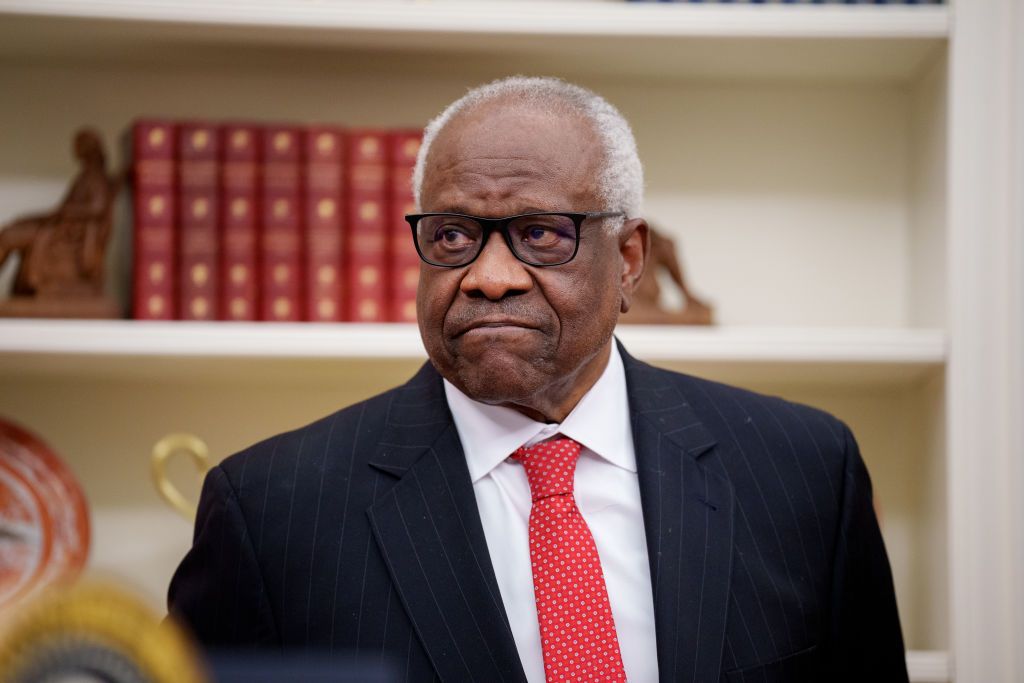
An interview with Sen. Ted Cruz on his biography of Justice Thomas
Randy Maniloff spoke with Sen. Ted Cruz about his new biography of Justice Clarence Thomas. Cruz, who conducted “over nine hours of one-on-one interviews” with Thomas while working on the book, said his goals for the project included raising awareness of Thomas’ "personal journey," which he says is “unlike any other Supreme Court justice.”
Contributor Corner
The foreign affairs origins of domestic executive supremacy
In a series of recent rulings, the Supreme Court has expanded presidential authority. In his Court Beyond Borders column, Martin Flaherty contends that the roots of this trend rest in earlier disputes over foreign affairs.
A Closer Look
Previewing the 2026-27 Term at the SCOTUSblog Summit
At our term preview event on Wednesday at Johns Hopkins University Bloomberg Center, we explored the Supreme Court’s work – and the upcoming term, in particular – from multiple angles. Speakers discussed highly anticipated oral arguments, ongoing debates over court reform, and how complicated it can be to predict the impact of a ruling in the immediate aftermath of its release.
The event began with a fireside chat between Zach Shemtob, SCOTUSblog’s executive editor, and Elizabeth Prelogar, a partner at Cooley and the former U.S. Solicitor General. Among other topics, they discussed how Prelogar prepares to argue before the court and whether arguments feel easier once you have several under your belt. (She confirmed that they do.) Prelogar also described how arguing before a court with a 6-3 conservative majority differs from arguing before a 5-4 court, explaining that there’s less of an incentive now for advocates to aim their arguments at a single swing justice. Instead, they are “thinking more creatively” to build a coalition of justices in support of their position.
After the fireside chat, Sarah Isgur, David French, and SCOTUSblog’s Amy Howe took the stage for a live recording of the Advisory Opinions podcast. They briefly reflected on the Supreme Court’s decision not to allow the Trump administration to implement parts of a rule on mail-in voting – agreeing that the court hasn’t seen the last of election-related disputes – before turning their attention to the term ahead. Isgur challenged Howe and French to name the most important case that’s been scheduled for argument so far, which led to a discussion of Viramontes v. Cook County, a Second Amendment case on whether bans on AR-15s and similar semiautomatic rifles are constitutional. Isgur contended that the most significant case is Suncor Energy v. County Commissioners of Boulder County, on whether federal environmental law supersedes state-law claims against oil and gas companies over their alleged role in exacerbating climate change. Isgur described it as a “huge culture war case.”
The next session was a discussion on Congress and the court, which featured Sen. Dick Durbin (D-IL) and Rep. Darrell Issa (R-CA), and was moderated by Elie Honig, senior legal analyst for CNN. While Durbin was more critical than Issa of how the Supreme Court is navigating the second Trump administration – for example, Durbin said that it’s a “serious problem” for the court to issue unexplained decisions on the “shadow docket” – both men agreed that it’s a difficult moment for the court, as Americans increasingly view it as a political institution. As to potential court reforms, Durbin asserted that it’s not “realistic” to expect Democrats to be able to increase the number of justices even if the party takes control of the Senate after November’s elections. Instead, he emphasized the need for the justices to consider working on their own to update the court’s ethics code; Issa agreed that it’s important for the ethics code to be strong.
The final panel of the afternoon brought together Brett Gerry, the chief legal officer of Boeing; Brian Callanan, the general counsel for TD Bank U.S.; and Jeff Taylor, the general counsel for ExxonMobil. At moderator David Lat’s prompting, they discussed how AI is affecting their work, what they look for in outside counsel, and their views on the Supreme Court’s “business docket.”
Look for additional coverage of the 2026 SCOTUSblog Summit on SCOTUSblog and Advisory Opinions in the coming days.
SCOTUS Quote
]]>MR. HORWICH: “… And the fact that it did not comment further should not be a reason to – to not pay attention to the structural and textual changes that it did make. I’d like to reserve.”
CHIEF JUSTICE ROBERTS: “Thank you, counsel.”
JUSTICE SCALIA: “We have tall lawyers today. What is this, tall lawyer day?”
— United States v. O'Brien (2010)
The modern trend toward an increasingly unchecked executive dates back at least to the Reagan administration, along with the rise of originalism and its institutional champion, the Federalist Society. An early manifestation came in the form of the so-called “unitary executive” theory, the idea that the president’s control over the executive branch should be subject to few, if any, congressionally imposed limitations. Justice Antonin Scalia passionately articulated the theory in his dissenting opinion in Morrison v. Olsen, objecting to statutory constraints on the president’s ability to remove an independent counsel. In time, such dissents became majority opinions. Majorities then came to move beyond unitary executive theory to endorse expanded executive power generally.
As in much else, the advent of Donald Trump represents a quantum leap in the assertion of presidential authority, often in ways formerly considered all but unthinkable. And no less striking, more often than not, the Supreme Court has gone along. Just last term, the unitary executive reached a high point when Trump v. Slaughter held that Congress could not limit the president’s plenary power to remove agency heads, overturning the 91-year-old, ostensibly well-settled Humphrey’s Executor v. United States. Beyond the unitary executive, the court has also blessed presidential immunity from certain criminal prosecution, invalidated nationwide injunctions to check dubious executive orders, and consistently sided with the administration in the emergency docket, allowing substantial harm to the interests of the challenging side even when the court hands the president a rare loss, as in the tariff case.
The court’s sanction of an ever more powerful and unchecked presidency is not without certain ironies. It comes precisely in the face of a president who has been consistently pushing boundaries in unprecedented fashion. It further comes with the justification that this is exactly the type of presidency that the Constitution’s founders conceived. As Justice Sonia Sotomayor’s dissent in Slaughter noted, not only is this assertion deeply contested. Among other things, it echoes the concern of even the pro-executive Alexander Hamilton, that “Of those men who have overturned the liberties of republics, the greatest number have begun their career by paying an obsequious court to the people; commencing demagogues, and ending tyrants.”
Yet the nation has seen this story before. Going back almost a century, it had already occurred in foreign affairs.
Take the founders’ commitment to diffused and shared power among the three branches of the federal government. Starting with the late Gordon Wood, historians have generally agreed that supporters of a new constitution embraced separation of powers as an abstract concept in reaction to the emergence of majoritarian tyranny in overly powerful state legislatures. In domestic affairs especially, it followed that any new national framework should have a stronger and more powerful executive and judiciary to check the legislative branch, which had shown how it could draw ever more power into its “impetuous vortex.”
But in foreign affairs the principal threat came not from Congress, but from a president that, among other things, would be the commander in chief of the armed forces. Leading founders agreed with Aristotle that “The tyrant is fond of making war in order that his subjects . . . be always in want of a leader.” Over and over they raised the concern that an unchecked federal executive could become a Caesar, Sulla, Henry VIII, Charles I, or Cromwell. As James Madison said at the Federal Convention, “A standing military force, with an overgrown Executive will not long be safe companions to liberty.”
To meet exactly these concerns, the founders sought to apply sketch a separation of powers framework with mutual checks and balances that would apply as fully in foreign as domestic affairs. Most obviously, the proposed Constitution allocated and blended powers among the three branches in foreign affairs as it did in domestic affairs. The president would make treaties, but only with the approval of two-thirds of a Senate that met a quorum. The courts would have the power to adjudicate treaties as the “supreme Law of the Land” even if they preempted state law. The president would be commander-in-chief. But Congress would “declare War,” and regulate and fund the armed forces. The judiciary, moreover, would have the power to adjudicate controversies involving the laws that resulted. Contrary to the vision of some scholars and several justices, the president was intended to be anything but “imperial from the beginning.”
And so this understanding held well into the 20th century. Yet over time, the United States grew from weak republic, to regional player, to world power, to hegemon, one for better or worse frequently involved in both hot and cold wars. That development inevitably led to presidents of both parties making ever more aggressive claims concerning the extent of exclusive executive authority. For well over a century, the Supreme Court turned aside such claims. Especially notable in this regard was Youngstown Sheet & Tube Co. v. Sawyer, which rejected President Harry Truman’s attempt to seize the country’s major steel mills in an effort to avert a nationwide strike during the Korean War.
With the Cold War and the rise of the national security state, however, the court hastened a long and uneven retreat. The retreat occurred on many fronts. But two, one niche, the other epic, illustrate the point. The first deals with the question who should interpret U.S. treaties. The other considers who oversees the running of a war.
The Constitution declares that treaties “shall be the supreme Law of the Land.” For various reasons, not all are. Some need to be incorporated into domestic law by Congress. But many do not and are “self-executing.” As federal law on par with acts of Congress, it would seem to follow that their interpretation should fall to the courts. Such was the expectation of the founders, and so it was for almost a century. During that time the courts would give zero deference to interpretations offered by the executive branch, even in cases in which the United States was a party. That changed just as the nation was becoming a world power. Starting in the late 19th century, the Supreme Court at least nominally began to declare that executive interpretations merited special consideration. A century later, that nominal deference is all but dispositive.
Running a war, of course, involves stakes that are exponentially higher. There has been endless debate as to what extent a president can initiate armed conflict without congressional approval. Suffice is to say that a preponderance of scholarship indicates that the founders sought to insure Congress’ involvement but for a narrow, mainly defensive, exception.
Yet what of the conduct of an armed conflict once begun? On that topic, imagine if Chief Justice John Roberts struck down an executive action partially exceeding a congressionally authorized armed intervention. Or invoked international law to interpret a statute to declare a military action illegal. Or disallowed an executive seizure of enemy alien property within the U.S. because international law limited the scope of Congress’ authorization to go to war. Chief Justice John Marshall did all this, and more.
The same could not be said of the current chief, or indeed several of his predecessors. The rise of the United States as an engaged world power has led to vastly increased claims of presidential power. In the past century, the court has increasingly accepted executive branch claims and given presidents of both parties an increasingly freer hand in foreign affairs.
Some of this has come through a robust state secrets doctrine, comparatively stricter standing and justiciability limitations, and hostility to plausible applications of international law and human rights standards. Trump v. Hawaii, to cite just one recent example, illustrates the pattern. In that case, the court considered whether the first Trump administration’s limitations on immigration from mostly Muslim-majority countries violated the establishment clause. Sotomayor in dissent noted that established doctrine would have permitted the court to look at the plethora of Donald Trump’s statements heralding the action as an “anti-Muslin” ban. Yet Roberts, writing for the majority, cited foreign affairs and national security consideration to preclude such statements and conclude that what the president himself called an “anti-Muslim” ban wasn’t an anti-Muslim ban after all. The net result of such decisions over time has created a constitutional imbalance of power in favor of the executive that would have alarmed the founding generation, and testifies to the long march toward presidential supremacy in matters of war and national security. (For that matter, so too does the ability of the current occupant of the White House to start a war without the prospect of any institutional check.)
Presidential supremacy in foreign affairs should serve as a warning on the domestic front. The current imbalance suggest that the founders knew what they were talking about. On their view, the Constitution abhors a concentration of power wherever that concentration may occur. (One corollary is to be skeptical of claims that the “original understanding” of the Constitution envisioned a monarchical presidency.)
A further warning points to excessive executive power coming not all at once, but in steps, any one of which may be dismissed as benign, or at least not much to worry about. Today’s degree of unchecked presidential authority in foreign affairs and national security suggests that the frog should take action whenever the range is turned up a notch.
Yet even these prospects might be tolerable with a chief executive who abides by the many unwritten norms of presidential conduct starting with President George Washington. That may not be the case with a president indifferent to such norms. Absent real institutional checks, legislative and judicial, there is little to stop such a leader and his associates from, as Hamilton observed, “commencing demagogues, and ending tyrants.”
]]>These early accounts of Thomas are shared by Sen. Ted Cruz in “Going Further,” his biography of the jurist, which was published on Aug. 25 and debuted at No. 1 on The New York Times best-seller list for non-fiction. Unlike many third-party histories, the senator had extensive first-hand access to his subject. Thomas gave Cruz over nine hours of one-on-one interviews for the work.
In an interview with SCOTUSblog, Cruz explained that, key to Thomas’ response to racism was using the strongest tool he had: himself. “He’s very driven. He’s very disciplined,” Cruz says. “He wanted to go and do things where he could put in the hard work and excel on his own on the merits.”
Making the pitch
Cruz, 55, visited Thomas’ chambers in early 2025 to pitch his idea of interviewing the justice for a potential biography. The two have known each other since 1996 when the would-be legislator clerked for Thomas’ colleague at the time, Chief Justice William Rehnquist.
Thomas agreed immediately to the proposal. Cruz points to his own background for why Thomas allowed him to do so. In addition to being a former law clerk, much of Cruz’s professional career was as a Supreme Court litigator. He is now a senior member of the Senate Judiciary Committee and has been involved in the confirmation process for many federal judges, including numerous Supreme Court justices.
The 78-year-old justice told Cruz: “If it were a law professor or somebody else asking, I would say no. … You being who you are, I think you can tell this story.”
The book owes its title to Thomas’ belief that the Supreme Court’s highest authority is the text and original meaning of the Constitution. Of the nine justices, Cruz says that Thomas is by far “the most willing to overturn precedent if he believes that precedent was wrong.” In other words, Cruz writes, “Justice Thomas has not hesitated in saying that it is never too late to go back – or, as he has often put it, to go further.”
The book’s objectives
Cruz shares one objective for the project on the book’s back cover. “Someone so extraordinary, you would think, would be venerated,” Cruz writes. “And, if he were politically liberal, he would be.” But instead of honorary law degrees and elementary schools bearing his name, “the response is silence. And hate. It’s time for that silence to end.”
While Cruz laments such unfair treatment, throughout the book he makes the point that Thomas is not particularly bothered by it. Asked about this, Cruz told SCOTUSblog, “He’s a strong man and he knows what he believes. He’s not looking for affirmation from others.” Cruz elaborated by sharing a story of Justice Stephen Breyer asking Thomas if he “wants to go talk to law professors who were expressing derision toward him.” Thomas replied: “Steve, no offense, but why would I give a damn what those people think.”
Cruz’s other purpose is to tell Thomas’ “personal journey,” which he says is “unlike any other Supreme Court justice.”
He traces Thomas’s life from a young boy, growing up in the South in poverty and confronting racism, to becoming a “full-on liberal and left-wing radical” in college, before ending up “one of the most important conservative thinkers who have ever lived.” “There is no area of jurisprudence that Clarence Thomas has had a bigger impact on than race,” Cruz tells SCOTUSblog. “His time as a justice has been a clarion voice for a colorblind Constitution.”
It then comes as no surprise that Cruz has much to say in “Going Further” about Thomas’ concurring opinion in Students for Fair Admissions, Inc. v. President & Fellows of Harvard College, the Supreme Court’s 2023 decision striking down as unconstitutional race-based admissions programs used by Harvard and the University of North Carolina.
While Thomas joined the court’s six-justice-majority, he wrote separately and took the rare step of announcing his concurring opinion from the bench.
Justice Thomas stated: “We cannot be guided by those who would desire less in our Constitution, or by those who would desire more. ‘The Constitution abhors classifications based on race, not only because those classifications can harm favored races or are based on illegitimate motives, but also because every time the government places citizens on racial registers and makes race relevant to the provision of burdens or benefits, it demeans us all.’”
Cruz notes that this passage is from Thomas’ own dissenting opinion in 2003’s Grutter v. Bollinger, where the court upheld the University of Michigan Law School’s use of race as a factor in admissions decisions.
“For generations, when all of us are dead and buried,” Cruz told SCOTUSblog, “you will have students and lawyers and judges reading Clarence Thomas laying out the incredible importance of not discriminating based on race.”
Personal journey
Reflecting on his approach to the law, Cruz writes that Thomas told him, “I’ve thought about jurisprudence and biography. And virtually none of this comes from Yale. Virtually none of it comes from scholars.” Justice Thomas concluded: “It comes from the way you’re raised.”
In August 1955, seven-year-old Clarence Thomas and his brother went to live with their maternal grandparents in Pin Point, Georgia. Their father had abandoned the family shortly after Clarence was born. It had become too difficult for their mother to raise them while trying to keep a full-time job.
The boys moved into their grandparents’ home. While modest, it contained modern comforts that had been lacking in some of their prior accommodations across Georgia, such as indoor plumbing and running water.
Their grandfather, Myers Anderson, was a disciplinarian. School was first and foremost in the boys’ lives. Anderson, who could neither read nor write, was determined that his grandsons get the education he’d been deprived.
A convert to Catholicism, Anderson took the boys out of the public school and enrolled them in one run by the Catholic Church. Clarence would serve as an altar boy.
Anderson stressed self-reliance, refusing to accept government assistance even when he was barely making enough to survive. As he saw it, accepting money from the government was opening the door to allowing it into your home and dictating how you lived.
When they were not in school, Clarence and his brother were working, which included helping their grandfather in his job delivering fuel oil or laboring on the family’s farm located several miles out of town. Playing sports, considered a folly by Anderson, was not permitted. The only acceptable substitute for work was a trip to the library.
Cruz writes that “all conversations about Justice Thomas’s early years, including the extensive ones I conducted with him to write this book, begin and end with Myers Anderson.”
Thomas, who referred to his grandfather as “Daddy,” wrote in his 2007 memoir, “My Grandfather’s Son,” that the man was “determined to mold me in his image. … He was the one hero in my life. What I am is what he made me.”
The influence of the Catholic Church caused Thomas to pursue the priesthood. His grandfather enrolled him in a high-school-level preparatory seminary in Savannah, Georgia. Thomas was one of only two Black students in the school. Cruz writes that his “fellow seminarians had various ways of letting him know he wasn’t welcome,” describing shunning and racial slurs that he faced.
Disappointed that the Catholic Church was not doing enough to address civil rights, and not liking what he was seeing in his fellow seminarians, Thomas began to doubt his decision to become a priest.
Nonetheless, upon graduation in 1967, he entered Immaculate Conception Seminary in Missouri to complete his studies. But his time there would be short-lived. On Apr. 4, 1968, Dr. Martin Luther King, Jr. was assassinated. Thomas witnessed his fellow students celebrating the tragedy. “Then and there,” Cruz writes, “he felt the last of his resolve to join the priesthood drain out of him.”
A few days later, Thomas attended a march in Kansas City in King’s honor. Cruz writes that Thomas would later recall the event as one in which “he felt a connection with people that he’d never felt at the seminary. Finally, he was among like-minded folks who saw the civil rights movement as a righteous cause – one that needed to live on even after the death of its most extraordinary leader.”
Thomas subsequently enrolled at the College of the Holy Cross in Massachusetts. Dressed in military fatigues and combat boots, Cruz writes that he “attended meetings of the Black Student Union almost as often as he attended classes.”
Cruz writes that Thomas found himself with students whose mission was to address inequality by any means necessary. But, in discussing this period in his memoir, Thomas wrote that he had “no desire to burn down the country that had given me a chance.”
Legal career
Upon graduation from Holy Cross, Thomas enrolled at Yale Law School.
In his book, Cruz describes the experience for him as “confusing.” While Thomas was looking for an education in the law, Cruz explains that he was confronted with professors promoting a doctrine known as “legal realism.” Under this theory, laws did not have to mean what their drafters understood them to mean. Instead, laws were malleable and judges were free to change them if they believed it “necessary” to do so.
In search of guidance, Thomas turned to older books about the origins of law and government. Cruz writes that “[w]hat struck him was how different the founders’ world looked from the abstract theories that dominated his classes.”
Cruz adds: “With every book he consumed about the United States and its founders, he became more convinced than ever that his grandfather’s ideas about the world had been correct all along.”
While Thomas “did quite well at Yale Law School,” Cruz told SCOTUSblog that “not a single law firm in the country would hire him. They all turned him down. Law firms said ‘no thank you, we don’t want you here.’” “He discovered that when it is widely known that your admission was in some significant part because of the color of your skin, rather than academic accomplishments, employers did not trust the credential and that you were ready.”
Cruz shares that Thomas took a 15 cent price tag from a box of cigars, stuck it on his Yale degree, and proclaimed “that’s what it’s worth.”
The newly minted lawyer took the only job he could get, going to work for Missouri Attorney General John (“Jack”) Danforth. But despite being desperate for work, Thomas still posed a condition on Danforth, telling him “I have no interest being the token Black man on staff. I don’t want to work on civil rights matters. I just want you to treat me like all the other assistant AGs you have on staff.” Danforth would later be elected to the Senate. Following a foray into corporate law at chemical company Monsanto, Thomas joined his staff in Washington, D.C.
In 1991, after nearly eight years as chairman of the Equal Employment Opportunity Commission and only 18 months as a judge on the U.S. Court of Appeals for the D.C. Circuit, Thomas was nominated to the Supreme Court by President George H.W. Bush. Today, he is less than two years away from being the longest-serving justice.
Cruz delves deep into Thomas’s confirmation hearing and the allegation by former EEOC employee Anita Hill that her then-boss subjected her to conversations about pornographic material. Hill’s charge came after Thomas’s testimony had concluded and resulted in both the accuser and accused famously telling their side of the story in a televised hearing before the Senate Judiciary Committee.
Cruz says he thought back to the Thomas-Hill testimony in 2018 when Supreme Court Justice-nominee Judge Brett Kavanaugh, following the conclusion of his confirmation hearing, was accused of committing a sexual assault in high school. Some of Cruz’s Senate colleagues were ready to ignore the allegations and vote to move Kavanaugh’s nomination out of the Judiciary Committee and onto the full Senate. But Cruz says he objected. He pointed to Anita Hill’s allegations and swayed his colleagues that, before doing so, the American people deserved to hear both parties testify and make up their own minds. Just as three decades earlier, hearings took place.
Plowing a field
Cruz describes Thomas’ “going further” approach to deciding cases using an analogy the jurist shared. While working on the family farm, he learned how to plow a field.
“When you’re plowing a field,” Thomas told Cruz, “it’s very important that the first row you plow be straight. If the first row is crooked, every other row will be crooked as well.”
Look at what the Constitution says, Cruz told SCOTUSblog. “And if the Court got it wrong, that first row is crooked. And all of the rest of the jurisprudence is crooked as well.”
Cruz offers an example. In 2005, in Kelo v. City of New London, the Supreme Court upheld the Connecticut town’s use of eminent domain to purchase Susette Kelo’s home, allowing the land it sat on to be used by Pfizer, Inc. as part of a parking lot for a research campus to be constructed.
At issue was the Fifth Amendment’s “Takings Clause,” which states that “private property” shall not be taken “for public use, without just compensation.”
Writing for the five-justice-majority, Justice John Paul Stevens stated that the decision turned on whether “the City’s development plan serves a public purpose.” It did, the majority concluded, pointing to economic benefits to the community, including new jobs and increased tax revenue.
Thomas joined Justice Sandra Day O’Connor’s dissent but also wrote separately to elaborate on the majority’s flawed focus on a “public purpose” to evaluate the permissibility of eminent domain, a term that is broader than “public use,” which is the phrase contained in the Constitution.
Thomas argued that the Supreme Court’s long-ago adoption of a “public purpose” standard in eminent domain cases was done “blindly, with little discussion of the Clause’s history and original meaning.” He then proceeded to fill in this oversight, including examining the framers’ understanding of eminent domain and drawing support for a narrow reading of “public use” based on the meaning of the word “use” as it appears in two other clauses in the Constitution.
Thomas concluded that “the Public Use Clause, originally understood, is a meaningful limit on the government’s eminent domain power” and the court should return to its “original meaning…: the government may take property only if it actually uses or gives the public a legal right to use the property.”
Following the Supreme Court’s decision, Kelo was forced to sell her land but she saved her home by moving it piece-by-piece to a new location. The planned development never came about.
Cruz told SCOTUSblog that “the reasoning in Justice Thomas’ dissent I think has prevailed in the national discourse. Many states, including my home state of Texas, have passed laws requiring that eminent domain be used only for a public use.” But Cruz says in “Going Further” that this was not his objective: “Justice Thomas does not write opinions – particularly dissents – because he believes he is shifting the direction of American law. … He simply says what he believes is true, steps back, and moves on to the next case.”
Samuel Alito was a Yale student a year behind Thomas, but they did not know each other. Years later, Thomas asked Alito why they weren’t friends. “Clarence, you were scary,” was his reply. Thomas, who says he wore bib overalls and combat boots in law school, objected to being called scary, but conceded that he didn’t suffer fools lightly.
“That’s the throughline of Clarence Thomas,” Cruz told SCOTUSblog after recounting this story. “Even as he is learning what he believes, he has that foundation that he had from his upbringing, from his grandfather.”
]]>
The in-person program will feature a live podcast recording of Advisory Opinions with special guests, a keynote address, a panel featuring Brett Gerry (CLO of Boeing), Brian Callanan (GC of TD Bank), and Jeff Taylor (GC of ExxonMobil), and more. A cocktail reception will follow.
Registration will open soon.
Today, SCOTUSblog and Johns Hopkins University are coming together to preview the cases and questions that will shape the 2026-27 Supreme Court term. This event, which is presented by Cooley, will include a keynote address featuring Sen. Dick Durbin (D-IL) and Rep. Darrell Issa (R-CA); a live taping of the Advisory Opinions podcast; a fireside chat with Cooley partner and former U.S. Solicitor General Elizabeth Prelogar; and a panel with Brett Gerry (chief legal officer of Boeing), Brian Callanan (general counsel of TD Bank U.S.), and Jeff Taylor (general counsel of ExxonMobil). Tomorrow’s newsletter will include a brief overview of the event.
At the Court
The Trump administration has asked the Supreme Court to clear the way for it to use the Department of Homeland Security’s Systematic Alien Verification for Entitlements database to identify noncitizens on state voter rolls. On Tuesday, the groups challenging this plan filed a response to the administration’s request. For more on the dispute, see the On Site section below.
Morning Reads
Trump calls Supreme Court mail ballot ruling ‘big loss for Republicans’
Dan Mangan, CNBC
In a Tuesday morning post on Truth Social, President Donald Trump “blasted the Supreme Court for blocking a new controversial U.S. Postal Service rule on mail-in ballots from being used for the upcoming midterm elections,” according to CNBC. “It is a big loss for Republicans, and America itself, and makes cheating by the Radical Left ‘Dumocrats,’ on Mail-In Ballots, a much easier thing to do,” the president wrote. In the post, “Trump also harshly criticized his three Supreme Court appointees,” Justices Neil Gorsuch, Brett Kavanaugh, and Amy Coney Barrett, “for apparently joining with all three liberal justices, plus Chief Justice John Roberts,” in Monday’s decision. “These are not the people I interviewed to serve on the United States Supreme Court, they are merely a shell of their original selves,” he wrote.
Todd Blanche: Supreme Court setback on mail-in ballots won’t stop election integrity efforts
Tom Howell Jr., The Washington Times
During a Tuesday press briefing, Attorney General Todd Blanche asserted that “efforts to tighten rules around mail-in voting will continue beyond November despite the Supreme Court’s refusal to step in and revive President Trump’s plan to police mail-in ballots for the midterm elections,” according to The Washington Times. “We’re not going to stop the work that we’re doing, but we are of course going to follow the orders of the court,” Blanche said, adding that the Supreme Court’s decision “doesn’t affect ongoing criminal investigations into illegal voting.” Blanche also addressed Trump’s complaints about the Supreme Court on social media. “He is very frustrated,” Blanche told reporters. “He has every right, and indeed he should, communicate his concerns with the Supreme Court whenever he has them. This isn’t the first time he’s done it, and it won’t be the last.”
John Eastman asks US Supreme Court to undo disbarment over Trump election efforts
David Thomas, Reuters (paywalled)
Conservative attorney John Eastman has filed a petition for review with the Supreme Court, asking the justices “to reinstate his California law license after he was disbarred in the state earlier this year over his efforts to overturn Republican President Donald Trump’s 2020 election loss to Democrat Joe Biden,” according to Reuters. In the petition, Eastman contends “his legal advocacy was protected by the First Amendment of the U.S. Constitution, and that he was disciplined in a ‘politicized’ bar proceeding. He said other attorneys who took part in legal proceedings that sought to overturn the results of the 2020 presidential election were not disciplined.” Reuters noted that “[i]t is rare for the U.S. Supreme Court to weigh in on attorney disciplinary cases, which are normally decided by the top court of respective states.”
EPA rollback may worsen Trump’s Supreme Court climate headache
Lesley Clark, Politico
On Oct. 5, Trump “administration attorneys will appear alongside oil companies at the Supreme Court to argue that the justices should put the kibosh on dozens of state court lawsuits that – if successful – would force companies like ExxonMobil, Chevron and Suncor Energy to pay billions of dollars for contributing to climate change,” according to Politico. In its filings in that case, Suncor Energy v. County Commissioners of Boulder County, the Justice Department has contended “that EPA – not the states and cities behind the climate lawsuits against oil producers – is the primary regulator of greenhouse gases.” However, legal experts who spoke with Politico believe that claim is in tension with “[t]he Trump administration’s move on Monday to undo EPA climate rules” for power plants and its broader effort to reduce EPA’s involvement in climate issues. For its part, the “DOJ has said it does not see any conflict with its decision to rescind climate rules and its Supreme Court argument that state-level climate lawsuits interfere with the federal government’s job.”
In Fits and Starts, the Supreme Court Stands Up to Trump
Adam Liptak, The New York Times (paywalled)
In an analysis for The New York Times, Adam Liptak explored the Supreme Court’s evolving relationship with the Trump administration, noting that, for much of President Donald Trump’s second term, “the court seemed to have settled on a strategy of deference, ducking and delay.” “But sometimes,” Liptak continued, “the court put its foot down,” including on Monday in the mail-in voting dispute. “The majority opinion about mail-in balloting on Monday was just three sentences long, but it went further than it might have. Instead of ruling merely that the administration’s plan had been rolled out too close to the November election, a conclusion that might have suggested Mr. Trump might still win in the end, the majority signaled that the government was likely to lose on the merits,” Liptak wrote.
On Site
Court News
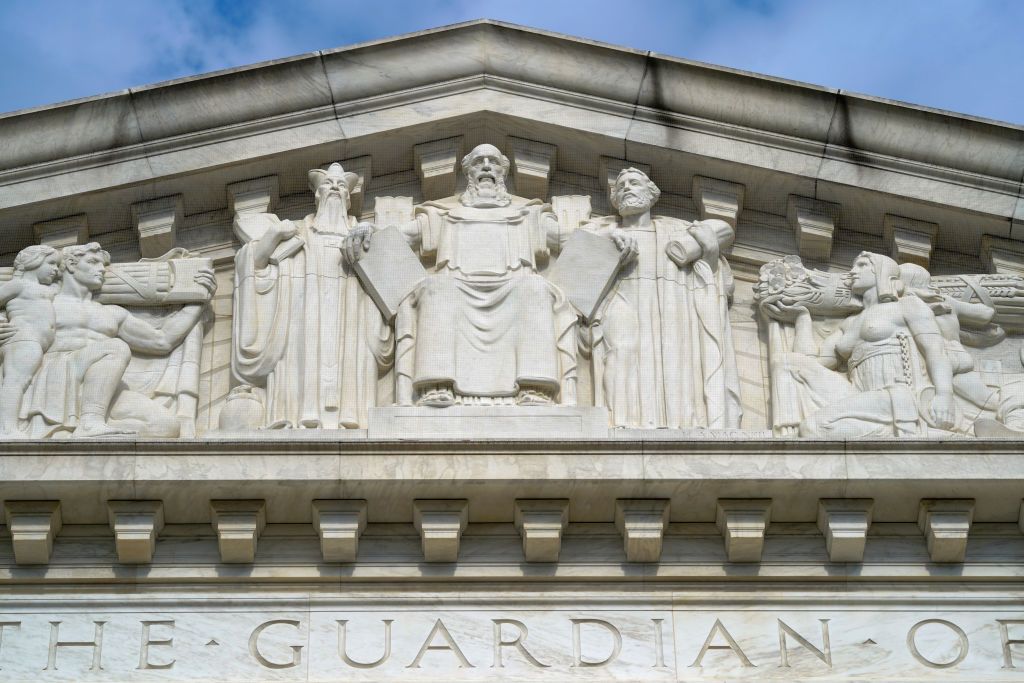
Groups urge justices to leave in place ruling barring Trump administration’s use of voter database
Lawyers for the League of Women Voters and the Electronic Privacy Information Center on Tuesday urged the Supreme Court to leave in place a ruling by a federal judge in Washington, D.C., that bars the federal government from using a centralized database to verify voters’ citizenship. Nikhel Sus, the lawyer representing the two groups, told the justices that, in violation of federal law, “the government has recklessly created an error-laden master citizenship database that endangers millions of Americans’ privacy and voting rights.”
Contributor Corner
Criminal cases coming in the new term – and why the court could and should do more
In his SCOTUSCrim column, Rory Little offered a brief overview of cases on criminal law and related issues that will be argued during the 2026-27 term, including “blockbuster” cases on bans on AR-15s and similar semi-automatic rifles, the size of juries, and what constitutes an excessive fine.
SCOTUS Outside Opinions
Break the Supreme Court law clerk cartel
For his series on what the Supreme Court can do better, Josh Blackman wrote about why he believes the court should shake up its current approach to hiring clerks by, among other things, preventing candidates from applying while they’re still in law school and requiring “clerks, following their clerkship, to work for two years in government service.”
Podcasts
Advisory Opinions
Barely Averting a Constitutional Crisis
Sarah Isgur and David French debate David’s latest column for The New York Times on the dispute over congressional redistricting in Missouri. Then, the two review two law articles: Andy Smarick of the Manhattan Institute’s elegantly simple piece on unenumerated rights, and University of Virginia law professor Caleb Nelson’s amazing yet horrifying publication on the unitary executive.
Ask Amy
Q: What are some of the reasons certain filings with the Supreme Court are sealed? How is this determined?
A: As the Reporters Committee for the Freedom of the Press noted in a blog post, filings can be sealed for a variety of reasons – for example, to protect people who are in the witness protection program, to redact the names of government informants or young people who are convicted of crimes, or for national security reasons – for example, in cases involving Guantanamo Bay detainees.
At the Supreme Court, the sealing of filings is governed by the court’s rules. A litigant who wants to file a document under seal must file a motion seeking permission to do so. That motion, the court’s rules provide, must “address whether the material in question was sealed in a lower court.” If it was, then the motion should indicate whether the material is still sealed and why it should remain sealed to maintain confidentiality. If the material was not sealed, then the litigant seeking to file it under seal should explain why the Supreme Court should keep it under wraps. Regarding the process itself: “Neither the motion to file a document under seal nor any document containing sealed material should be submitted through the Court’s electronic filing system,” the court’s rules specify.
The Supreme Court heard oral argument in January 2023 in a case in which the petition for review was filed under seal: In re Grand Jury, a challenge by an unnamed law firm that received a grand jury subpoena for its communications with a client. The challenger also filed a public version of its petition that (among other things) has the name of the firm redacted, as well as a supplemental sealed volume of the appendix to the petition for review.
A slightly different variation on sealed filings can be found in Social Security and immigration cases, in which federal rules limit online access to the filings in the case – including at the Supreme Court.
SCOTUS Quote
]]>MS. MILLETT: “… And what the State Department looks for is – what it has said is that it has – it has a pattern of decisionmaking, factors it lays out in its brief, that I think it finds – it says it finds – influential in the process.
But in – forgive me for –”
CHIEF JUSTICE ROBERTS: “Finish your sentence.”
MS. MILLETT: “But in any given case, the role of the Executive Branch is going to have more or less deference based on whether it is speaking something within its traditional expertise: Are you a head of state?
Were you a diplomat?
But when it comes to war – and I – I'm not saying it would, but if it were to come to war with the very elements of the Torture Victim Protection Act and say that torture by an individual can be immunized just because it was done under color of law, then I think the court has a very difficult concern that was flagged in Altmann to resolve, and I think we might draw a different – we would definitely come to a different answer than the Executive Branch in that situation.”
CHIEF JUSTICE ROBERTS: “You made that a long sentence.”
— Samantar v. Yousuf (2010)
The filing came less than 24 hours after the Supreme Court rejected the federal government’s request to be allowed to implement portions of a U.S. Postal Service rule on mail-in ballots – which, like the database at the center of this case, the Trump administration said was necessary to combat election fraud.
The dispute has its roots in a March 25 executive order that (among other things) instructed the Department of Homeland Security and the Social Security Administration to establish systems that would allow state and local governments to verify voters’ citizenship and immigration status. Those agencies then overhauled the Department of Homeland Security’s Systematic Alien Verification for Entitlements database, known as the SAVE system, to include the records of U.S.-born citizens, to give it access to Social Security numbers, and to allow users to conduct multiple searches simultaneously.
The League of Women Voters and the Electronic Privacy Information Center went to federal court in Washington, where they challenged the changes to the SAVE system. On June 22, U.S. District Judge Sparkle Sooknanan blocked the government from using the modified system, agreeing with the challengers that it violates federal privacy laws, the Social Security Act, and the federal laws governing administrative agencies.
Sooknanan wrote that “the federal government has knowingly trampled on the privacy rights of American citizens in a manner that threatens the sacred right to vote.” Moreover, she continued, “states have partnered with the federal government to access the database and are actively removing United States citizens from voter rolls based on inaccurate information.”
By a vote of 2-1, the U.S. Court of Appeals for the District of Columbia Circuit on Sept. 4 rejected the government’s request to put Sooknanan’s order on hold while the appeal moves forward, but it ordered the appeal to be fast-tracked. The court instructed the litigants to propose a briefing schedule by Sept. 14, but the litigants later agreed that the briefing schedule should be postponed until the Supreme Court acts on the Trump administration’s request.
U.S. Solicitor General D. John Sauer then came to the Supreme Court on Sept. 8, asking the justices to pause Sooknanan’s ruling while the government’s appeal moves forward. He called Sooknanan’s decision an “indefensible order that threatens the integrity of upcoming elections by vacating the federal government’s authority to internally use Social Security data when fulfilling its duty to respond to requests by States to verify the citizenship of individuals for voting and other purposes.” Moreover, he added, Sooknanan did not have the power to enter her order because the challengers do not have a legal right to sue, known as standing. Among other things, he wrote, the federal government is not the source of any injury that the challengers and their members might suffer, because the SAVE system “merely notifies the States whether the federal government can confirm citizenship.”
In their filing on Tuesday afternoon, the groups pushed back against the government’s argument that they lack standing because the states, rather than the federal government, would be the source of any injury to them. That contention cannot be squared with the Supreme Court’s own cases, Sus wrote, which have “repeatedly recognized that a plaintiff has standing if ‘”third parties will likely react” to the government [action] “in predictable ways” that will likely cause . . . the plaintiff’s injury.’” “‘It is hardly surprising,” Sus continued,” “that additional voter verification and potential voter disenfranchisement is “the predictable effect of” the federal government incorrectly informing a state that an individual may be ineligible to vote.’ Indeed,” he concluded, “the government concedes this is the intended effect.”
The groups also told the justices that the federal government was reading too much into a provision of federal immigration law – which, Sauer had argued, trumps any other federal law, like the Social Security Act or the Privacy Act, that might prevent DHS from obtaining or disclosing information. Accepting that interpretation, Sus countered, “would give DHS unlimited power to vacuum up millions of Americans’ sensitive information from SSA (or any other agency) and disclose it in bulk to states however it wants.” If Congress had intended to give DHS that “extraordinary power,” Sus suggested, “it would have done so clearly and expressly.” But not only has it not done so, Sus emphasized, but “several bills that would expressly authorize the SAVE modifications have failed in Congress.”
Finally, the groups said, there is no real harm to the government if it cannot move forward with the modified system while the litigation continues. The pre-2025 SAVE system will remain in place, they stressed, and government agencies can continue “to use SAVE for individualized citizenship checks as they did for decades prior to 2025.” Moreover, they added, “[t]he government also lacks a substantial interest in operating a citizenship database it admits is error-prone and unreliable.”
]]>***
Every year, each justice hires four law clerks. Under the current practice, the justices will hire young lawyers with sterling credentials who secured two or three prior clerkships from “feeder” judges. Often, interviews are scheduled while applicants are still in law school, and before they have even started their first clerkship. Justices have built elaborate screening networks with former clerks, as applicants have to traverse multiple rounds of interviews. The justices would acknowledge that for every clerk that is hired, there are many more equally qualified candidates. Getting the job is like winning the gold medal at the Olympics – you are the best of the best but conditions have to be just right.
During the term, the clerks are privy to most things that happen at the court. The information they learn makes them extremely valuable. Accordingly, clerks are handsomely rewarded. Some law firms pay signing bonuses in excess of $700,000, even as former clerks are barred from practicing before the court for two years. Invariably, these former clerks often become the biggest boosters for their justice and the court itself.
I have been critical of this law clerk cartel. Far too much power is granted to people with so little experience. As a thought experiment, I proposed how Congress could phase out Supreme Court law clerks altogether. This plan is extremely unlikely. But perhaps the justices can constrain their own process.
Justice Ketanji Brown Jackson has taken some important first steps. For starters, she only considers applicants who have already completed an appellate clerkship. This step eliminates the unusual phenomenon in which law students are applying for Supreme Court clerkships before actually completing, or even starting, their first clerkship. Moreover, Jackson limits the application process to the submitted materials. There are no backdoors or secret paths to the clerkship. The notice states clearly that “[n]o information will be considered outside of the formal application process.” And references are barred from contacting the justice: “Neither applicants nor their references, recommenders, or other advocates should contact Justice Jackson or her current or former staff regarding a pending or prospective application.” If there are any doubts, the penalty is stated clearly: “Failure to follow this instruction may disqualify an application from further consideration.”
Good for KBJ. Perhaps as the newest member of the court, she is still able to assert control over the hiring process before it explodes beyond her control. Other justices could have followed her lead, but they apparently have not.
I would adopt all of Jackson’s preconditions and go several steps further. First, the justice should ask all of their clerks, following their clerkship, to work for two years in government service, for a non-profit, or some other public interest work. Implicit in this commitment is a postponement, or even rejection, of the gratuitous signing bonus. The justice would make clear that they are looking to hire clerks with an eye towards public interest. Moreover, these clerks will likely get far more practical experience following their clerkships outside of the private sector, where they can do far more good.
Second, I have proposed that the justices should spend part of their time working in the courthouses across the country. Their law clerks should join them. This project is mostly about keeping the judges grounded, but I do think there is value in keeping the law clerk’s feet planted on the ground. Working in a marble palace can distort any sense of reality. Perhaps law clerks could spend part of the year in the home chambers and part of the year at the Supreme Court. Or some law clerks could spend all of their time in either location. Or perhaps a justice could go to D.C. without any law clerks.
The third proposal will perhaps be the most draconian: the clerks should be barred from talking about cases with anyone in other chambers. Books and exposés about the Supreme Court recount how law clerks will often engage in shuttle diplomacy between the chambers. Documents about the so-called “Shadow Papers” may have leaked from someone who kept clerkship records from 2016. The law clerks become part of the deliberations. This approach may be useful and convenient for the justices, but I think it can distort the power structure. The clerks should be reminded that the justices are in charge, and they are just helpers. If the clerks are unable to talk with other chambers, then perhaps the justices would be forced to talk to each other more. And that is a very good thing.
***
This concludes my eight-part series on unilateral Supreme Court reform. The first installment proposed eliminating the summer recess. The second installment urged the justices to hold regular press conferences. The third installment called on the justices to hold oral argument outside of Washington, D.C. The fourth installment considered how the chief justice could share much of his power. The fifth installment would restore the practice of the justices riding circuit. The sixth installment would enhance the Supreme Court minority’s procedural powers. And the seventh installment proposed empowering the Supreme Court’s supermajority on substantive matters.
My sincere hope is that this series will generate discourse and debate. Unlike most proposals for court reform, these ideas should garner bipartisan support. None of them purport to change how many justices there are and how they decide cases. All of these proposals would maintain the independence of the court. Indeed, many of these ideas could be adopted by the justices unilaterally. Ultimately, the justices should not be bystanders in debates about SCOTUS reform. If the justices take the initiative to adopt reforms on their own, the impetus for external reform will decline. These changes would not only be good for the court but society as a whole.
]]>In fact, 11 of the 25 cases already granted for review are, by my calculation, criminal law and related (what I call the court’s “CLAR” cases). They won’t all be headline-grabbers, but 40% of the court’s docket is a very healthy chunk. And the court will surely grant some more after its Sept. 28 “long conference.” I provide more details on the already granted cases below. But first:
The court can and should take more criminal cases
Before discussing the merits of the current 11 CLAR cert grants, I want to point out that the court could do much more. Last month the Congressional Research Service put out a 68-page report on “Circuit Splits from 2025.” That little-reported document details almost 100 cases in which lower courts have disagreed (just in 2025?) on significant federal points of law. The Supreme Court has statutory jurisdiction to address such lower court “splits,” whether from federal or state courts. The Supreme Court’s Rules 10(a) and (b) expressly note that lower court “splits” on federal questions – that is, cases from different courts that disagree on some important point of federal statutory or constitutional law – are a reason for the court to grant review. Granting Supreme Court review on lower court splits makes sense, as national uniformity on federal issues is a major, and one of the oldest, reasons for having (as Article III of the Constitution begins) “one supreme Court.” What’s more, I have to believe that the CRS report did not come out of the blue but was prepared with the knowledge of (and perhaps even encouragement from?) folks in the solicitor general’s office.
By far, the largest category of unresolved such “circuit splits” listed by CRS is criminal law and procedure, with 28 cases – three times larger than the next category, civil procedure. The report provides case citations for all 28 of these (at least one from every circuit except the U.S. Court of Appeals for the 5th Circuit). Just a few examples of important questions that need settling: Is embezzlement a continuing offense that extends the statute of limitations? Is car-jacking a violent felony when the state statute also reaches extortion? Is criminal forfeiture limited to property a defendant has actually acquired (here a cert petition may be pending)? What intent is required for a civil rights violation on a county road?
To make an oft-repeated point, the Supreme Court used to decide as many as 150 cases per term. But during the 2025-26 term the justices heard argument after full briefing in only 58. According to a Federalist Society report that has often been repeated, in 2012 Chief Justice John Roberts said that the court could hear “100 cases without any stress or strain, but the cases just aren’t there,” and he “emphasized that circuit splits are far and away the most important consideration.” The capacity of the justices to handle more cases is not an issue – more grants of review to provide national uniformity in criminal cases ought to be a priority.
Criminal-law-and-related cases already set for the 2026-27 term
The court has issued argument calendars for the last three months of 2026. As detailed below, there are two CLAR cases set for argument in the October sitting and three for the November sitting. The blockbuster AR-15 and criminal forfeiture cases will not be heard until Dec. 1 and 2. The case where I expect the court will rule, non-textually but universally, that serious criminal case juries must always have 12 and not six jurors is still unscheduled and so will not be argued until 2027.
Below are my relatively brief descriptions and observations on the CLAR cases set for argument so far in the coming term. The hyperlink for each takes you to the SCOTUSblog page for the case, where you can then find links to all the filings and other information about it. I address the three “biggest” cases first, and then the other eight in order of their scheduled oral arguments. Keep in mind that more criminal cases are likely to be granted after Sept. 28.
Semiautomatic rifles, 12-person juries, and excessive fines
- Viramontes v. Cook County (Dec. 2, consolidated with Grant v. Higgins): Like another nine states, Connecticut and Cook County, Illinois, have laws that ban possession of what they call “assault weapons.” The term is defined to include semi-automatic rifles like the AR-15 (and the Second Amendment Foundation petitioners do not challenge fully “automatic or burst fire” weapon bans). The question whether legislatures may ban semi-automatic weapons has been brewing for years, and last term Justice Brett Kavanaugh wrote that the court would “soon” address it. The solicitor general has now asked to join the oral argument over whether such “categorical” bans are consistent with the Second Amendment. The case will attract huge media attention and the one hour scheduled for oral argument is likely to go much longer.
Because these consolidated cases will attract much attention from other columnists, I won’t go into much detail. The U.S. Courts of Appeal for the 7th and 2nd Circuits both denied the firearm owners’ challenges, finding procedural flaws in each case. But the question – narrow, in the sense that even if the court reverses, a remand for specific application will be necessary – remains: Does the Second Amendment allow bans at all on semiautomatic rifles? I will add only the following textualist thought, about a small-but-radical change between the language of District of Columbia v. Heller and now.
The 2008 Heller decision, which changed precedent to find a Second Amendment right to own handguns for self-defense, was decided 5-4. To me (and others) it is clear that Justice Antonin Scalia had to include various qualifiers in his opinion, or he would have lost one or two of his five votes and Heller would have come out differently. Part III of the opinion was clearly added to capture, or keep, the narrow but earth-shattering majority, and ought to be viewed as the binding judgement of the court. Specifically, in addition to listing various “longstanding prohibitions on the possession of firearms” left undisturbed, part III said “we also recognize another important limitation on the right to keep and carry arms. ... the sorts of weapons protected were those ‘in common use at the time’” (quoting United States v.Miller, a 1939 precedent upholding bans on machine guns). I add emphasis on “at the time,” because the Viramontes briefing all but ignores what the court said was this “important limitation.”
As the solicitor general’s brief notes, “the AR-15 rifle was developed in 1956,” and the first semiautomatic rifle of any kind was sold in 1903. Thus, while they may be the “most commonly owned rifle[] in America” today (albeit by less than 10% of all Americans), semi-automatic rifles were undisputedly not in common use “at the time” the Second Amendment was adopted in 1791. Indeed, as the SG’s brief also explains, it is the modern technological developments in the AR-15 that makes it popular today. (This is also why they are commonly used in mass-shootings.) Rather, the solicitor general’s Viramontes brief subtly changes the language, saying (on page 21) that the proper Second Amendment test is whether AR-15s “are in common use” today (again, my emphasis). This radically departs from the doctrinal limits that were essential to cementing the Heller result. In his 2025 dissent from denial of certiorari, Kavanaugh (joined by Justice Samuel Alito) adopted this same semantic transfiguration of Heller (changing “were” to “are”) – an error (or strategy) presaged in Kavanaugh’s 2011 Circuit judge dissent when Heller was remanded in 2011. Many folks will be listening on Dec. 2 to see whether a majority of justices will agree that Heller did not actually mean what it appeared to say.
- Kian v. Florida (unscheduled): Unlike Viramontes, Kian will be, I think, easy for the court, even if non-textual. So easy, it appears to me, that the parties and the court have agreed that an appendix presenting the underlying record is unnecessary. Whether the Sixth Amendment’s right to a “jury” trial for all criminal prosecutions requires a 12, rather than six, person jury, has been pushed by Justice Neil Gorsuch for years: in his view, when the framers wrote “jury” they understood this to mean it consisted of 12 members. Amicus professor Akhil Amar agrees, saying that “[a] proper criminal jury means twelve good persons, nothing less. In 1791 and 1868, the number twelve was implicit in the word ‘jury’.”
To rule for Kian, the court will have to overturn a divided 1970 precedent (Williams v. Florida) that upheld Florida’s six-person jury practice, over Justice Thurgood Marshall’s dissent that a jury of 12 is required. Williams reviewed the Sixth Amendment’s history and concluded that “precisely 12” was an “accidental feature” of juries at the time. But decades earlier, the court had seemed to hold that 12 persons are required. Then Gorsuch’s opinion in 2020’s Ramos v. Louisiana overruled a similar jury trial precedent allowing non-unanimous criminal conviction verdicts. As Alito suggested in his Ramos dissent, that decision seems to lead directly to a similar implied rule: that a criminal trial “jury” means, constitutionally if also implicitly, 12 persons. The case for overruling Williams has been around for years, and I think it will pose little difficulty for a majority in Kian.
Former Solicitor General Seth Waxman (confession: also my former law-practice colleague) will argue for Kian, and it should be lively whenever it occurs. A more difficult question – whether Kian should be applied retroactively as a “new rule” to challenge former six-person-jury convictions – may be discussed and even decided, but it’s unnecessary to resolve the question presented here.
- Jouppi v. Alaska (Dec. 1): One of my frequent, if nonsensical, classroom bon mots is that “facts make the law, not the other way around.” The soundbite facts of Jouppi are that Jouppi’s plane was taken by the state as a criminal forfeiture for illegally transporting a six-pack of beer. As my friends on Advisory Opinions note in their fun discussion of the case, there are other facts that might reduce one’s sympathy (such as nine gallons of beer in the back of the plane and that Jouppi’s passenger ran a bar in the area), but still this case looks like a “libertarian’s dream[].” And although Gorsuch has resisted the libertarian label, he seems to become a dispositive “wild card court” justice for the “little guy” when the government looks like a bully.
All this suggests a ruling for Jouppi – but the question presented is more general: whether the Eighth Amendment’s no “excessive fines” provision should be applied “purely in the abstract” or by reference to a defendant’s specific wrongdoing. This distinction grows out of a 5-4 decision, 1998’s United States v. Bajakajian, which found a $357,144 fine for a currency reporting failure to be unconstitutionally excessive. Justice Clarence Thomas wrote that a fine is constitutionally excessive if “grossly disproportional to the gravity of a defendant’s offense.” His language there appears to have left room for argument now: did the justices mean the defendant’s offense specifically, or the gravity of that type of offense in general?
There is a serious split here, among state as well as federal courts, and last term’s excessive fines case (Pung v. Isabella County) did not address it. Oral argument will likely be full of hypotheticals as to how any resulting constitutional test might be applied, even if the justices end up putting aside, perhaps with a grin or two, the forfeiture of Jouppi’s $95,000 plane for transporting a six-pack of beer as excessive under any test.
All that said, forfeiture of instrumentalities of crime, things used to facilitate the crime itself, has long been a feature of criminal law. And deciding on the scope of forfeiture is generally thought of as more a legislative than a judicial task. The framers of the Constitution put only “excessive,” not all, forfeitures out of bounds, and left little guidance for precise application of the concept. Because Jouppi will provide significant guidance for thousands of criminal forfeiture actions, which not incidentally bring in billions of dollars for all levels of government, it will be one of the most significant criminal law decisions in the coming term.
Another seven criminal-law-and-related cases next term
Space considerations and the attention span of even knowledgeable readers for this sort of thing counsels shorter descriptions here. The descriptions are my own, not necessarily the court’s. Argument dates and the criminal law topic are bolded. One case is set for argument in October, five in November, and one is still not scheduled.
- Beaird v. United States (Oct. 13): Is there a more nuanced way to describe the deferential standard for official commentary published by the U.S. Sentencing Commission to explain the federal Sentencing Guidelines? Must federal courts follow the Commentary even if it conflicts with an unambiguous Guideline ? The solicitor general ended up supporting a ruling for the defendant here, so Anthony J. Dick, a former clerk to Alito, has been appointed to defend the 5th Circuit’s prior rulings on the question whether the strict deferential standard for Commentary announced by a 9-0 1993 decision (Stinson v. United States) is still correct. When it granted cert in this case, the court wrote its own short question for the parties to address. But its brevity – is Stinson still correct? – is deceptively simple.
- Maxwell v. Dinis (Nov. 2): Is a claim that a prisoner is entitled to release to a halfway house cognizable in a federal habeas corpus action? This case is a rare pro se prisoner petition granted for review. Once a response to the petition was requested by the court, a high-powered law firm arranged to represent him (Masha Hansford, who has previously argued nine cases as an assistant to the solicitor general). Another former clerk to Alito, Brian W. Barnes, has been appointed to defend the 5th Circuit’s ruling that release to a halfway house is not a release from custody subject to habeas relief, because the solicitor general said that position is “inconsistent” with prior Supreme Court cases.
- Younge v. Fulton County (Nov. 2): This is a civil procedure case involving the firing of a supervising prosecutor in a county district attorney’s office. May a civil defendant assert an affirmative defense well past the civil procedure Rule 16 deadline to support a summary judgement motion? Unlike other circuits, the U.S. Court of Appeals for the 11th Circuit has said yes if the plaintiff is not “prejudiced” by it.
- Guerrero v. Johnson (Nov. 4): This is a state death penalty case involving a claim of “intellectual disability,” a topic which has recently engaged the court. Here, a threshold issue is presented: is a “new rule” of constitutional law available for retroactive application in a habeas petition, if it could have been raised in a prior petition even though it was viewed as meritless at that time? The new-rule-doctrine is complicated; the question is what does a rule that was “presently unavailable” mean, as used in the habeas statute that governs state criminal convictions. The 5th Circuit ruled that it means “previously unavailable” (with a dissent from Judge James Ho to a 9-7 denial of rehearing en banc). The U.S. solicitor general has agreed in an amicus brief that the 5th Circuit’s interpretation is “unsound” – we’ll see if the SG asks to also participate at oral argument, since the habeas statute applicable to federal convictions has the same “previously unavailable” language.
- Nielsen v. Watanabe (Nov. 9): The real question here is will the court overrule Bivens v. Six Unknown Federal Narcotics Agents, a 6-3 decision issued in June 1971? Bivens was perhaps the last hurrah of the liberal Warren court – four months later both Justices Lewis F. Powell and William H. Rehnquist were confirmed to replace famed liberal Hugo Black and moderate John Marshall Harlan II. Bivens allowed a private cause of action for damages under the Fourth Amendment against federal agents who violate constitutional rights. That idea was extended in 1980 to Eighth Amendment claims for deliberate indifference to a prisoner’s medical issues, in Carlson v. Green. This case (Nielsen) involves a similar, but of course not identical, Eighth Amendment claim, and the U.S. Court of Appeals for the 9th Circuit – traditionally a red flag for conservative critics – upheld Nielsen’s claim (despite 10 en banc dissenters).
Bivens has been criticized, but also applauded, since the day it was decided. The court has rejected similar constitutional damages claims consistently since Carlson, and in 2022 Gorsuch called Bivens a “misstep” that the court should step away from.
Francis Nielsen is a federal prison paramedic who allegedly told an injured prisoner to “stop being a cry baby” and failed to treat his injury, leading instead to two months of solitary confinement without medical treatment for what turned out to be severe injuries. The 9th Circuit ruled that Watanabe’s claim against Nielsen and others could go forward on a Bivens/Carlson theory. Nielsen, who is represented by former Assistant to the Solicitor General Jeffrey A. Lamken, argues directly that Bivens should be overruled. As amicus, the solicitor general has asked to participate in oral argument, and suggests that the court might want to wait for a case decided under the Fourth Amendment like Bivens to consider overruling it.
On Nov. 9, Bivens will likely be vigorously defended by the three liberal justices. A legal regime in which a person who is intentionally injured by a federal agent’s violation of a constitutional right and has no remedy for damages is undoubtedly in tension with the famous Marbury v. Madison idea that every violation of a right deserves a remedy. But the anti-Bivens handwriting seems to be starkly on the wall.
Two cases presenting statutory “plain language” as well as circuit splits that the solicitor general agreed the court should resolve
- Wassily v. Blanch (Nov. 30): This is another important immigration case, after five others decided by the court this past year. Are persons who were once “granted asylum” but whose asylum status was later terminated for serious criminal convictions, categorically ineligible for adjustment to lawful permanent resident status? The statute says that “any alien granted asylum” may apply for such status, but the solicitor general argues that the 2nd Circuit was correct to rule that the statute is intended to apply only to persons who are presently in asylum status.
- Montoya Palacios v. Liggins (not yet scheduled): Can a successful habeas corpus action used to challenge immigration detention be eligible for an award of attorneys’ fees and costs under the Equal Justice Act? Habeas actions are filed as civil, not criminal, cases, and the statute says that “any civil action” other than those “sounding in tort” can qualify. But the solicitor general argues that habeas actions have been viewed differently than other civil actions in the past, and it’s true that Schlanger v. Seamans, decided in 1971, said that habeas cases are “not automatically subject to all the rules governing ordinary civil actions.” At the same time, that decision referred to “rules,” not “statutes.” Merits briefing has been extended into December so further analysis awaits.
Chief Justice William Howard Taft, who famously joined the Supreme Court after serving as president, was born on this day in 1857. Jordan Lorence recently wrote for SCOTUSblog about the concept of “Taft-maxxing” (yes, you read that right).
At the Court
On Monday, the Supreme Court denied the Trump administration’s request to pause a district court ruling preventing implementation of parts of a new U.S. Postal Service rule on mail-in voting. Justice Brett Kavanaugh wrote a concurring opinion. Justice Samuel Alito wrote a dissenting opinion, joined by Justice Clarence Thomas. Learn more about the decision in the On Site section below.
The Trump administration has asked the Supreme Court to clear the way for it to use the Department of Homeland Security’s Systematic Alien Verification for Entitlements database to identify noncitizens on state voter rolls. A response to the administration’s request is due today by 4 p.m. EDT.
Morning Reads
Trump's mail-in voting restrictions blocked by a second judge
Luc Cohen, Reuters
Ahead of the Supreme Court’s Monday decision on the “U.S. Postal Service rule that tightens mail-in voting requirements,” a second federal judge paused implementation of new USPS restrictions, according to Reuters. Late on Sunday, U.S. District Judge Carl Nichols “granted a request from the Democratic Party and groups including the NAACP for a preliminary injunction blocking the rule, which they argued was an unlawful intrusion by the federal government into election administration.” “The judge, who was appointed by Trump during his first term in the White House, wrote that the new rule could make it harder for some people to vote by mail and that the new regulation exceeded the Postal Service’s authority.”
A barrage of cases hitting the Supreme Court is stirring midterm confusion
Julian Mark, Mark Berman, and Justin Jouvenal, The Washington Post (paywalled)
In recent months, a “barrage of high-stakes election cases” has been addressed by the Supreme Court on its interim docket, and there are more decisions – and disputes – to come. Legal experts told The Washington Post that the number of cases is already “above historical norms, especially for a midterm election,” and expressed concern that the “flurry of litigation” will fuel distrust in the electoral process, not to mention confusion. The Post noted that “[e]lection-related cases have been increasing for decades, but three factors have sharply accelerated the trend this year: a Supreme Court decision weakening the 1965 Voting Rights Act, which prompted Southern states to quickly draw new, sometimes contested electoral maps; Trump’s pressure on GOP-led states to redraw their own maps, and Democrats’ efforts to respond in kind; and Trump’s aggressive push to introduce new voting rules.”
Supreme Court to decide whether to hear Maine lobsterman’s challenge to GPS boat tracker requirement
Patrick Whittle, Associated Press
On Sept. 28, the justices will meet to consider, among other things, “whether to hear a lobster fisherman’s challenge to a government requirement that boats use electronic tracking devices,” a case that “could have broad consequences for the American commercial fishing industry,” according to the Associated Press. “Maine lobsterman Frank Thompson filed” the lawsuit “over a [state] requirement that he install a GPS tracker on his boat to keep his fishing license.” “Thompson asserted that the monitoring constituted unreasonable search and seizure, but a federal appeals court denied his claim last year.” The AP noted that “[f]ishing groups have used the courts over the years to try to curtail monitoring requirements with mixed results. Authorities have said the lobster boat monitoring program is important to improve understanding of the valuable crustacean’s population at a time when it appears to be declining in New England.”
How a Street Brawl Led to a 5th Circuit Case That Casts Doubt on the Constitutionality of Many Federal Laws
Jacob Sullum, Reason
In February 2024, a street brawl in New Orleans led to “dozens of gunshots.” “One of the bullets struck a woman’s leg, and another woman was stabbed.” Curtis Squire was among those arrested in connection with that incident and “charged with attempted second-degree murder.” Prosecutors later “dropped that charge after ballistic testing showed that the Glock pistol found in Squire’s home did not match the gun fired during the melee.” However, “Squire, who had previously been convicted of heroin distribution, still faced a federal charge under 18 USC 922(g)(1), which criminalizes gun possession by people with felony records,” according to Reason. Squire is now challenging his conviction under that law, contending “that Congress had no constitutional authority to enact Section 922(g)(1), which criminalizes purely intrastate, noncommercial conduct under the pretense of regulating interstate commerce.” Squire’s case is pending before the full U.S. Court of Appeals for the 5th Circuit, and some court watchers hope it will eventually lead the Supreme Court to revisit “modern Commerce Clause jurisprudence.” Reason noted that Justice Clarence Thomas “reiterated his skepticism of the Commerce Clause justification for federal bans on intrastate gun possession” in a concurring opinion in a Second Amendment case decided during the 2025-26 term.
In Missouri, A Judicial Response to Politicized Election Administration
Bob Bauer, Democracy Project
In a column for NYU Law’s Democracy Project, Bob Bauer revisited the Supreme Court’s decision to prevent Missouri from using a new congressional map designed to favor Republicans in November’s elections, reflecting on what it might tell us about how the justices – and judges in general – approach disputes over election administration. “The Missouri case suggests, though it can never be certain, that the courts will be alert to the most egregious forms of politicized administration. Maybe that is all that can be hoped for: that the worst instances of this conduct will affect how the courts resolve election law controversies,” Bauer wrote. “This checking function could prove crucial in the months before and even after the election.”
On Site
Court News
Supreme Court denies Trump administration’s request to implement parts of rule on mail-in voting
The Supreme Court on Monday declined to allow the U.S. Postal Service to carry out parts of a new rule on mail-in voting. In a brief, unsigned order, the justices left in place a ruling by a federal judge in Boston that bars the USPS from implementing aspects of the rule.
From the SCOTUSblog Team
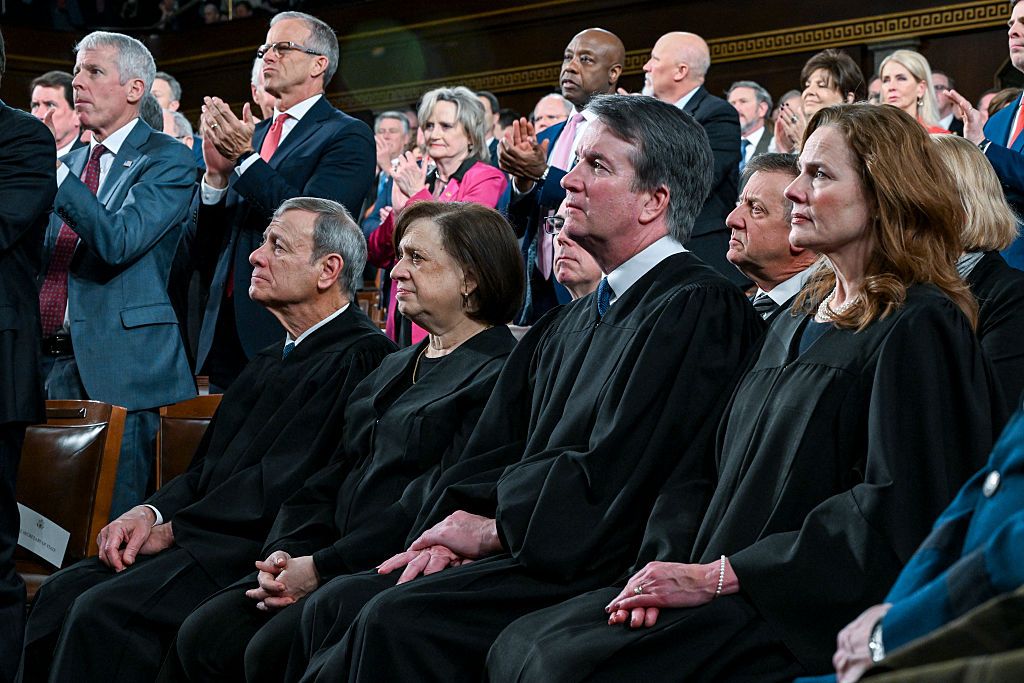
When justices drift
When President Donald Trump announced that he would nominate Amy Coney Barrett to the Supreme Court, he praised her “towering intellect, sterling credentials, and unyielding loyalty to the Constitution.” Those words stand in stark contrast to his complaints about her after she ruled against his signature tariffs. Nora explored the phenomenon of presidents having “buyer’s remorse” as to their Supreme Court picks and how the vetting process is evolving to try and prevent “judicial drift.”
Contributor Corner
The “born free and equal” clauses and the noxious Buck v. Bell
In his Born Free and Equal column, Steven Calabresi explored the role of the “born free and equal” clauses in what he described as “one of the most atrocious rulings in Supreme Court history: the 1927 case of Buck v. Bell, in which the court, 8-1, upheld a model eugenics statute.”
A Closer Look
Clarence Gideon
This is the seventh entry in our Closer Look series on famous Supreme Court plaintiffs. Today, we look at Clarence Gideon, the plaintiff in 1963’s Gideon v. Wainwright, which established that indigent defendants accused of serious crimes have a right to a court-appointed lawyer in state court under the Constitution's Sixth and 14th Amendments.
Clarence Earl Gideon was born on Aug. 30, 1910, in Hannibal, Missouri. His father, Charles, was a shoemaker, who passed away when Gideon was just three years old. Gideon’s mother, Virginia, remarried when Gideon was five, but Gideon never got along well with his stepfather. Speaking of his childhood, Gideon said, “My stepfather never could accept me or I could not accept him. My mother was very strict and my life as a child was of the strict[est] discipline.”
When Gideon was 14, he ran away from home and went as far west as California, saying he “accepted the life of a hobo and tramp in preference to my home.” After about a year, he returned home to Missouri and lived with his uncle.
Gideon’s encounters with the law began upon being discovered living with his uncle by his mother. She had Gideon sent to a jail in Hannibal for absconding. However, after a day, Gideon escaped from jail and broke into a country store to steal winter clothes, which landed him a three-year sentence in reform school. Gideon later said he was badly whipped and beaten in the reform school. He was paroled after a year.
Upon his release, Gideon began working at a shoe factory, which paid up to $25 a week, and got married. After about a year, he was laid off from his job at the shoe factory and his interactions with the law resumed. “I [was] without a job and I committed some crimes in 1928. I was caught and [through] a court appointed attorney was sentenced to the Missouri Prison for ten years for robbery with three sentences of Burglary and [larceny] running concurrently,” said Gideon. Around this time, he also got divorced.
Gideon was paroled in 1932, but with little education and work experience, he was unable to find employment in the midst of the Great Depression. Gideon again resorted to stealing and was arrested and sentenced to prison four times between 1934 and 1940. In 1943, Gideon escaped from prison and ended up on the most wanted list in True Detective magazine. Using a fake name and having forged a Selective Service card, he worked as a brakeman on the Southern Pacific Railroad until he was caught in 1950 and incarcerated once more. He was again arrested in 1951 for breaking into a home in Texas.
In 1955, Gideon married Thelma Kurtz. The couple owned “Smitty’s Bar,” a pool hall and beer parlor in Orange, Texas. After six months in Orange, the two divorced. Later that year, Gideon married Ruth Ada Carpenter Babineaux – they had three children together and moved to Panama City, Florida. During this time, Gideon worked as a cook and ran gambling games.
In 1961, Gideon was arrested for breaking and entering into the Bar Harbor Poolroom in Panama City. At Gideon’s trial, he requested a court-appointed lawyer, but the judge denied his request. After representing himself at trial, Gideon was convicted by a jury and sentenced to five years in prison. His appeal to the Florida Supreme Court, on the grounds that he was not provided the right to counsel, was summarily dismissed.
Gideon then appealed his case to the U.S. Supreme Court. “The question is very simple. I requested the court to appoint me an attorney and the court refused,” Gideon wrote in his handwritten petition for certiorari. In 1962, the Supreme Court agreed to hear Gideon’s case and assigned the accomplished lawyer Abe Fortas (who would later serve on the court) as his court-appointed counsel.
In March 1963, the court sided with Gideon in a unanimous opinion, which held that the Sixth Amendment’s right to counsel clause provides indigent defendants, accused of serious crimes, with attorneys. In his majority opinion, Justice Hugo Black wrote, “lawyers in criminal courts are necessities, not luxuries.”
Gideon was retried on the same charges that he was originally convicted of. This time he had counsel. On retrial, Gideon was found not guilty by a jury.
In 1963, Attorney General Robert F. Kennedy said at a speech to the New England Conference on the Defense of Indigent Persons Accused of Crime: “If an obscure Florida convict named Clarence Earl Gideon had not sat down in his prison cell with a pencil and paper to write a letter to the Supreme Court ... the vast machinery of American justice would have gone on functioning in its accustomed way.”
For the remainder of Gideon’s life, he continued to work odd jobs. Gideon passed away in January 1972 at 61 years old, either from cancer or complications from tuberculosis. He was buried in Hannibal. A made-for-television film about the case, “Gideon’s Trumpet,” adapted from a 1964 book by Anthony Lewis, was released in 1980 and starred Henry Fonda, who played Gideon.
In November 1984, the American Civil Liberties Union purchased a gravestone for Gideon, which included a line from a letter from Gideon to Fortas, stating: “I believe that each era finds an improvement in law for the benefit of mankind.”
SCOTUS Quote
]]>SOLICITOR GENERAL KAGAN: “Mr. Chief – excuse me, Justice Scalia – I didn't mean to promote you quite so quickly.”
(Laughter.)
CHIEF JUSTICE ROBERTS: “Thanks for thinking it was a promotion.”
— United States v. Comstock (2010)
Justice Brett Kavanaugh penned a one-paragraph concurrence in which he agreed with the decision to deny the government’s request. He suggested that, in his view, the Postal Service might have the power to issue the rule. But even if it does, he continued, election officials “do not have sufficient time to reasonably implement the rule before” the November elections.
Justice Samuel Alito dissented from the court’s ruling, in an opinion joined by Justice Clarence Thomas. He argued that some of the challengers in the dispute do not have a legal right to sue, known as standing, “while the remainder are pursuing a claim that this Court has recently called a ‘Hail Mary pass’ that ‘rarely succeeds.’”
The court’s order comes less than two months before the midterm elections in November. At least two states – North Carolina and Alabama – have already begun to send out ballots by mail.
As part of his administration’s broader effort to combat alleged voter fraud, President Donald Trump in March signed an executive order that directed federal agencies to take a series of steps on mail-in voting. For example, it required the Department of Homeland Security to send each state a list of the adult U.S. citizens in that state at least 60 days before a federal election and instructed the U.S. attorney general to investigate and prosecute state officials who allow people who are not eligible to vote to cast ballots.
A group of 23 states, led by California, and the District of Columbia went to federal court in Massachusetts to challenge the government’s efforts to implement the executive order. They argued that the order clashes with provisions in the Constitution that give states the power to determine voter eligibility and to set the “Times, Places, and Manner” of holding congressional elections.
U.S. District Judge Indira Talwani agreed. In an order on June 25, she temporarily prohibited the federal government from implementing parts of Trump’s executive order on or before the upcoming November elections in California, the states joining the lawsuit, or D.C.
On Aug. 24, the Supreme Court put Talwani’s order on hold, allowing the Trump administration to begin implementing the executive order. The majority explained that the states’ challenge had come too soon because the order had not yet been carried out – and, therefore, the states had not suffered the kind of injury that would allow their lawsuit to go forward.
Three days later, Talwani issued a new order that prohibited the Trump administration, for 14 days, from requiring states to comply with several provisions of a new rule issued by the U.S. Postal Service to implement Trump’s executive order – for example, imposing requirements for the design of the envelopes used to mail ballots and for the submission of voter data into a USPS portal.
The Trump administration returned to the Supreme Court on Sept. 3, asking the justices to pause Talwani’s second order. U.S. Solicitor General D. John Sauer withdrew that request three days later, after Talwani issued a preliminary injunction, which replaced her Aug. 27 temporary restraining order and barred the Trump administration from requiring states to comply with provisions of the USPS rule indefinitely while the litigation continues.
Sauer instead filed a new request with the Supreme Court, seeking to block Talwani’s preliminary injunction. He argued that Talwani’s “continuing prejudgment of the rule is baseless,” and her rationale is “simplistic,” and he rejected any suggestion “that the Postal Service is trying to federalize the rules for mail-in voting.” Instead, he wrote, “the Postal Service’s final rule imposes only modest envelope-design and addressee-information requirements for federal-election ballots sent via U.S. Mail.” Without a stay of Talwani’s order, Sauer continued, states will be able to mail out ballots that do not comply with the new rule.
California and the other states countered that “USPS’ unprecedented experiment with our Nation’s most cherished franchise—the right to vote—is unlawful.” And they suggested that the effects of a stay could lead to “chaos,” with some states unable to comply with the rule by the November elections, “meaning that millions of voters would be unable to vote by mail and some would not be able to vote at all.” Moreover, they added, “even if state and local officials were somehow able to implement the new rule perfectly, there is a high risk of technical breakdown, ineptitude, and delay on the part of USPS.”
A “friend of the court” brief filed by state and local election officials – including Republican secretaries of state from Kentucky, North and South Dakota, Georgia, New Hampshire, and Kansas – echoed this caution. They told the court that “[a]ttempting to implement the Rule now will almost certainly lead to mistakes, delays, and confusion for both voters and election officials.”
A brief filed on Wednesday by the League of Women Voters and other civic groups, which had filed their own challenge to one part of the rule, also urged the court to leave Talwani’s preliminary injunction in place. The groups told the justices that “Congress charged the Postal Service with delivering the mail nationwide, subject to a scheme of narrow exceptions for specified categories of material that Congress itself—not USPS—has deemed ‘nonmailable’ and subject to rules of general application such as sufficient postage. Mail ballots fall outside those congressionally prescribed exceptions.”
In an order issued on Monday night, the court indicated that the “Government is unlikely to succeed on the merits of its challenge to” Talwani’s order – a key factor in determining whether to grant the relief that the government was seeking. “And the equitable factors applicable for obtaining emergency relief from this Court” – such as whether the government will be permanently harmed if Talwani’s order is not put on hold – “do not favor a stay,” the court added.
In dissent, Alito contended that the Trump administration “has made the showings necessary for a stay.” First, he reasoned, the civic groups challenging the rule had relied on “cryptic filings” to assert their right to sue. But they must “make specific allegations establishing that at least one identified member had suffered or would suffer harm,” Alito stated, and provide that member’s name.
As for the states, Alito continued, the dispute boils down to “whether the Postal Service has statutory authority to promulgate the rule.” In this case, Alito asserted, the challengers must meet a high bar, but they cannot do so, because the USPS “has broad authority to regulate the mail.”
Alito agreed with the Trump administration that it would suffer permanent harm if Talwani’s order is not put on hold while the litigation continues, because it would not be able to implement the rule in time for the November elections even if her injunction is ultimately reversed. “[T]he Government,” Alito emphasized, “has a strong interest in enforcing the rule.”
By contrast, although Alito made clear that he took “th[e] problem” of “the practical effects of implementing the rule close to the midterm elections” “very seriously,” he concluded that “it is not enough to convince me to deny the application.” Some states, he noted, support the rule and say that they can comply with it during the November elections. Moreover, he suggested, the challengers and the courts “bear a substantial share of the blame” for the delay in the implementation of the rule.
]]>Article I. All men are born free and equal, and have certain natural, essential, and unalienable rights; among which may be reckoned the right of enjoying and defending their lives and liberties; that of acquiring, possessing, and protecting property; in fine, that of seeking and obtaining their safety and happiness.
In my initial articles, I showed that the “born free and equal” idea is deeply rooted in American history and tradition as that phrase is used in such correctly decided cases as Washington v. Glucksberg (rejecting a right to assisted suicide), McDonald v. City of Chicago (recognizing that the Second Amendment’s right to own a handgun for self-protection extends to the states), and Dobbs v. Jackson Women’s Health Organization (overturning Roe v. Wade). In the second and third article, I argued that while the 14th Amendment does not give rise to a “right to privacy,” it does through the privileges or immunities clause constitutionalize the “born free and equal” clauses, subject to rational basis review, which justifies the outcome, although not the opinions in 1965’s Griswold v. Connecticut (holding that states may not criminalize the use of contraceptives by married couples) and in 2003’s Lawrence v. Texas (holding that states may not criminalize same-sex “sodomy”). And in my fourth article, I examined the application of the “born free and equal” clauses to yet another famous “right to privacy” case: 2015’s decision in Obergefell v. Hodges, which correctly found a national constitutional right to same-sex civil marriages.
Today I turn to one of the most atrocious rulings in Supreme Court history: the 1927 case of Buck v. Bell, in which the court, 8-1, upheld a model eugenics statute. Specifically, a Virginia act allowed the compulsory sterilization, for the supposed “protection and health of the state,” of anyone who was deemed by a “social worker” to have genes resulting in feeblemindedness, unfitness, or an intellectual disability. Only a perfunctory hearing was allowed to those who were compulsorily sterilized.
This statute did not come out of nowhere. Rather, such eugenics laws were first championed in 1883 by the social Darwinist Sir Francis Galton, a second cousin of Charles Darwin who chillingly believed that there were many different human “races” on the earth and that those races of human beings were competing for what psychologist and philosopher Herbert Spencer called “the survival of the fittest.”
Galton, who was fascinated by the concept of animal breeding of dogs and racehorses, dreamed of applying this to human beings so as to promote the most intelligent, physically strong, and beautiful or handsome of them. (Darwin himself had hinted at such an idea in “The Origin of Species,” and mentioned it in his 1871 book “The Descent of Man.”)
Support for eugenics laws became an orthodox staple of the creed of the Progressive Era. In one letter, President Theodore Roosevelt stated that:
Society has no business to permit degenerates to reproduce their kind … Any group of farmers who permitted their best stock not to breed, and let all the increase come from the worst stock, would be treated as fit inmates for an asylum … Some day we will realize that the prime duty, the inescapable duty of the good citizens of the right type is to leave his or her blood behind him in the world; and that we have no business to permit the perpetuation of citizens of the wrong type. The great problem of civilization is to secure a relative increase of the valuable as compared with the less valuable or noxious elements in the population … The problem cannot be met unless we give full consideration to the immense influence of heredity.
Woodrow Wilson, the other major Progressive politician of the first part of the 20th century, signed a eugenics bill into law as governor of New Jersey. Other famous eugenicists included William Howard Taft; Margaret Sanger (the founder of Planned Parenthood); and Winston Churchill. Indeed, as home secretary from 1910 to 1911, Churchill argued for eugenic government intervention regarding people categorized at the time as “feeble-minded” or “insane.”
In addition, major early philanthropic foundations like the Carnegie Institution and the Rockefeller Foundation provided extensive financial grants to eugenics organizations, such as the Eugenics Record Office at Cold Spring Harbor Laboratory, under the direction of leaders and trustees who subscribed to the pseudoscience of the era.
This extended to the universities as well. James Rowland Angell, who was president of Yale from 1921 t0 1937, and Charles William Eliot, who was president of Harvard from 1869 to 1909, were outspoken and virulent eugenics supporters. (Elliott served as a vice president to the first International Eugenics Congress held in London in 1912.)
The court itself perhaps most prominently embraced this movement in Buck v. Bell.
In upholding Virginia’s compulsory sterilization law, Justice Oliver Wendell Holmes, Jr. wrote for the majority that:
It is better for all the world, if instead of waiting to execute degenerate offspring for crime, or to let them starve for their imbecility, society can prevent those who are manifestly unfit from continuing their kind. The principle that sustains compulsory vaccination is broad enough to cover cutting the Fallopian tubes. ... Three generations of imbeciles are enough.
In the wake of the Supreme Court’s ruling, 70,000 Americans were compulsorily sterilized, and 32 states ended up adopting compulsory sterilization statutes like Virginia’s. Nazi jurists and race hygienists studied U.S. sterilization statutes, such as California’s eugenics programs, as well as the Buck v. Bell decision. These laws inspired Adolf Hitler’s Nazi government to pass a German eugenics law in July 1933 entitled a “Law for the Prevention of Offspring with Hereditary Diseases” a few months after the Nazis came to power. Ultimately, 400,000 people were sterilized by the German law. The same racist ideology that led to these compulsory sterilizations in Hitler’s Nazi Germany undoubtedly helped fuel the ideas behind the Holocaust.
Such ideas could not be in greater contrast to the Lockean principle that “All men are born free and equal.” That idea was thriving in the 1780’s when the Constitution was adopted; it was thriving during Reconstruction and in President Abraham Lincoln’s Gettysburg Address; but by 1912 it had effectively died out. The “born free and equal” idea only reemerged in 1948 as an Article I right in the Universal Declaration of Human Rights after the horrors of the Nazis and the Holocaust began coming to light.
***
Buck v. Bell was egregiously wrong not only as a matter of morals, but under the “birthright equality” principle that underlies the citizenship clause of the 14th Amendment. Citizens, as I explained in my prior articles, are born equal (i.e., they are born to be neither slaves nor lords). The citizenship clause grants equal rights unto the feeble-minded and the geniuses of this world alike.
The right to have children, like the right to marry (the purpose of which is often to have children) is obviously deeply rooted in American history and tradition. The Preamble of our Constitution states that one of the six purposes of that document is: “To secure the Blessings of Liberty to ourselves and our Posterity”. It goes without saying, I think, that a government which is compulsorily sterilizing its citizens based on a social worker’s finding of feeblemindedness is not securing the “Blessings of Liberty to ourselves and our Posterity.”
The landmark 1823 decision of Corfield v. Coryell, which I have previously said is the 14th Amendment’s version of the “born free and equal” clauses, stated that:
The inquiry is, what are the privileges and immunities of citizens in the several states? … They may … be all comprehended under the following general heads: Protection by the government; the enjoyment of life and liberty, with the right to acquire and possess property of every kind, and to pursue and obtain happiness and safety; subject nevertheless to such restraints as the government may justly prescribe for the general good of the whole [people].
As noted, Americans cannot “enjoy … life and liberty” or “pursue and obtain happiness and safety” if they face the risk of compulsorily sterilization. But can such laws then be justified under Coryell’s rational basis test (in bold), i.e., that such laws are “just” and are enacted for the “general good of the whole [people]?” Certainly not. A government that could compulsorily sterilize the feeble-minded would also be able to compulsorily sterilize any population that has fallen out of favor, whether Jewish or Black people, Native Americans, or Latinos. Nor, even if such a policy for the “feebleminded” was justified, could it be properly implemented (as was true in Buck’s very own case).
The Supreme Court distinguished but did not overrule Buck v. Bell in 1942’s Skinner v. Oklahoma after it became terribly apparent what eugenics led to. Someday, the Supreme Court should formally overrule this terrible precedent.
In the meantime, Harvard Law School should cancel its annual, prestigious “Oliver Wendell Holmes Lecture.”
Three generations of Holmes Lectures are enough.
]]>Trump is certainly not the first president to have “presidential buyer’s remorse,” as Harvard Law School professor Jon Hanson called it. President Dwight Eisenhower, for one, chose Earl Warren as chief justice in 1953 because, among other things (including having promised him a seat on the court a year earlier in exchange for Warren’s political support) the California governor’s philosophy “pleased” him. Within a decade, however, Eisenhower supposedly called Warren’s appointment “the biggest damn fool mistake I ever made.” (There is some debate as to whether he actually said this.)
Judge Laurence Silberman of the U.S. Court of Appeals for the District of Columbia Circuit spoke of a potential cause for the phenomenon of ideological drift in a 1992 speech to the Federalist Society. There, he argued that The New York Times’ legal reporters existed mainly to “put activist heat on recently appointed Supreme Court justices,” who might then move leftward to “curry favor with or avoid criticism from the Washington press corps.” “Tom Sowell,” a prominent conservative economist and social theorist, Silberman continued, “described this technique as the ‘Greenhouse Effect.’”
Sowell coined the eponymous term in a column after Linda Greenhouse, the Times’ longtime Supreme Court correspondent (“[p]erhaps the most influential journalist who denigrates conservative judges and lionizes those on the left,” from Sowell’s point of view). According to Sowell, this phrase describes “the susceptibility of judges to such journalistic influence in general.” “The idea” of the “Greenhouse effect” “is that once confirmed, justices become desperate to be invited to the right cocktail parties and conform their views to those of the liberal intelligentsia,” as Slate reporter Dalhia Lithwick has characterized it.
Whether due to the Greenhouse effect or not, historically there has been significant frustration over judicial “drifting”: In the words of Silberman, “those of us who had been involved in judicial selection had watched with great disappointment as jurists seemed to change on the bench – or, as the press would say, ‘grow.’”
Perhaps exhibit A in modern times is Justice David Souter. John Sununu, who served as the governor of New Hampshire before becoming the chief of staff to President George H.W. Bush, “assured” conservatives in 1990 that the former New Hampshire Supreme Court associate justice would be “a home run,” even though Souter was a relative unknown who had spent just three months on the U.S. Court of Appeals for the 1st Circuit. Two years later, Souter joined Justices Anthony Kennedy and Sandra Day O’Connor in Planned Parenthood v. Casey to reaffirm the “essential holding” of Roe v. Wade. Over time, he came to align with Justice John Paul Stevens (another Republican appointee) as one of the most liberal justices on the court. Since then, it has become a mantra for some in the conservative legal movement to have “no more Souters”; that is, to rigorously guard against the type of jurist who would drift leftward.
So has this effort proven successful? And what does success look like here?
The “drifters”
A history of modern justices drifting to the left appears to be more than just anecdata. University of Virginia political scientist Larry Sabato estimated in 2005 that roughly a quarter of the justices confirmed over the preceding half-century turned out more moderate or liberal than expected. In 2007, political scientists Lee Epstein, Andrew Martin, Kevin Quinn, and Jeffrey Segal used justices’ ideological scores (known as Martin-Quinn scores, which “estimate each justice’s ideological position by modeling voting coalitions in non-unanimous cases”) to show that nearly every justice since 1937 had ideologically drifted during his or her tenure, and that presidents could expect their appointees to vote as predicted only for their first few terms.
President Richard Nixon, for example, selected Justice Harry Blackmun on the understanding that he was a rock-solid conservative – only for him to pen Roe v. Wade three years later. Stevens, who was nominated by President Gerald Ford, eventually proved the court’s most consistent liberal, coming to lead the left wing of the court. And Kennedy, once hailed as “Bork without the beard,” authored the court’s majority opinions in both Lawrence v. Texas and Obergefell v. Hodges, which held, respectively, that a Texas law criminalizing same-sex sexual conduct violated the due process clause and that the 14th Amendment gave same-sex couples an equal right to marry. Even arch-conservative Chief Justice William Rehnquist moved leftward over time, especially after his appointment as chief.
Other than the Greenhouse effect, several explanations have been offered for such drifts. Georgetown law professor Mark Tushnet argued that Justice Antonin Scalia’s “acerbic comments on his colleagues’ work” may have occasionally driven Kennedy into the arms of his liberal colleagues. Souter himself said he knew little about federal constitutional law when confirmed and formed his views on the job, coming to see himself as sticking to the precedents of the Warren and Burger courts while his conservative colleagues departed from these.
Along those lines, Hanson and Drexel law professor Adam Benforado have argued that the job changes people, as a justice who must decide real cases with real parties may not rely on the same intuitions that got him or her nominated. As Judge Richard Posner of the U.S. Court of Appeals for the 7th Circuit once put it based on his own experience, being a judge “is bound to moderate one’s views.”
The pipeline
In the face of such drift, one criticism (at least on the right) has been that Republican presidents and their staff have done a markedly poor job vetting their picks. There may be some truth to this claim, but it’s not entirely convincing. President Ronald Reagan’s Justice Department ran what a leading historian of judicial selection called the “most systematic philosophical screening” of judges in American history – this process produced Rehnquist as chief justice and Scalia, but also the more moderate O’Connor and Kennedy.
Law professor Michael Dorf has written that for every Republican nominee since Nixon (and up to 2007, when his paper was published), one variable – prior service in the federal executive branch – is an important predictor of whether a justice would “evolve.” Chief Justice Warren Burger and John Roberts, as well as Rehnquist, Scalia, and Justices Clarence Thomas and Samuel Alito had such experience (and therefore remained ideologically “solid,” with perhaps the exception of Roberts), while Blackmun, Powell, Stevens, O’Connor, Kennedy, and Souter had no such experience. According to Dorf, this phenomenon may stem from committed conservatives seeking out and working for the Justice Department in Republican administrations, while presidents have reached for somewhat unknown outsiders when they wanted to avoid a confirmation fight.
Others (in line with the Greenhouse effect) have focused more on what happens to the justices once they join the court, arguing that people respond less to public opinion than they do to the elite networks around them; as such, the argument goes, organizations must instead focus on “situational influences” that affect a judge’s behavior. One study tried to measure the effect using ideological scores for every Republican appointee from 1982 through 2021, and found that Republican appointees without a Federalist Society affiliation, for example, drifted left by about 0.07 points per year on the Martin-Quinn scale, while affiliated justices drifted right by about 0.05.
Today’s court
The current administration has taken ideological drift quite seriously. When the time came for Trump to nominate a Supreme Court justice to Scalia’s seat in 2017, he had already “worked closely with conservative legal groups like the Heritage Foundation and the Federalist Society to compile a list of potential nominees, which he released before the election,” according to SCOTUSblog's contemporaneous coverage. Various other media outlets reported that Leonard Leo, then executive vice president of the Federalist Society, at Trump’s request, “drew up the lists of potential justices that Donald Trump released during the 2016 campaign,” and “advised Trump on the nominations of Neil Gorsuch, Brett Kavanaugh and Amy Coney Barrett.”
In 2018, the lawyers advising Trump on Kennedy’s replacement reportedly “huddled on the fourth floor of the Eisenhower Executive Office Building for days to review the writings and opinions of the leading candidates … [and] continued sharpening the briefing and vetting materials.” The same year, Trump remarked that “[w]e’re going to have great judges, conservative, all picked by the Federalist Society.”
So how has this pipeline fared? Like many other things, it depends on who you ask and what metrics you use.
Trump’s first nomination to the Supreme Court, Gorsuch, measures as relatively conservative – his Martin-Quinn score places him as the third-most conservative justice on the current court, behind Thomas and Alito. Yet it’s a bit more complicated than that: Gorsuch is also the court’s most frequent bridge to the liberals in dissent, joining them in eight of his 46 dissents since Justice Ketanji Brown Jackson arrived on the court. And in the tariffs case, Gorsuch signed onto Roberts’ majority opinion in full (and wrote an even broader concurrence), striking down the president’s signature economic initiative and thereby incurring Trump’s wrath.
Kavanaugh is perceived to be less conservative than Gorsuch by some measures, and more so by others, specifically when it comes to the interim docket (again, it’s what metric you use!). In merits cases, Kavanaugh often aligns with Roberts, of whom the contemporary right is no fan, yet he was also the only member of the court’s center-right to side with the president in the tariffs case, writing the principal dissent and (whether he wanted it or not) garnering the president’s praise.
As for Barrett, she sits closest to the center according to several metrics. On the current court, she has also “drifted” the most leftward, according to an analysis by Adam Feldman; a separate study found that her share of conservative votes in divided cases fell from 65% in the 2020 term to 57% in the 2023-24 term. During the 2025-26 term, she also voted against two of the president’s most prominent executive orders (in both the tariffs and birthright cases), unlike Kavanaugh and Gorsuch. For this, she has generated a great deal of anger from the right.
Is “drift” even a fair standard?
Of course, whether Barrett has drifted depends on what “drift” means. Despite some prominent “defections,” she has joined her conservative colleagues in the majority of contentious cases on the merits and interim dockets.
But, perhaps most importantly, a justice’s judicial philosophy and the outcomes the party that nominated her support can be two different things. Barrett would argue that she is applying an originalist methodology regardless of where it leads, whether in Trump’s favor or to the president’s detriment. And, indeed, if a political movement’s constituency measures justices’ votes simply by their outcomes – as opposed to the reasoning used to get there – a pipeline’s success may look to that constituency like failure. While this might displease the partisans among us, some would argue that’s exactly the point of judicial independence.
]]>Today is Justice Ketanji Brown Jackson’s birthday. Born in 1970, Jackson has served on the Supreme Court since 2022.
At the Court
On Friday, the Supreme Court dismissed a case on whether certain noncitizens have a right to a bond hearing that had been scheduled for argument in October, after U.S. Solicitor General D. John Sauer notified the court that the case is now moot and the challenger agreed that it should be removed from the oral argument docket. For more on the dismissal, see the On Site section.
On Sept. 6, the Trump administration urged the Supreme Court to allow it to fully implement a new U.S. Postal Service rule on mail-in ballots. The dispute is now fully briefed, and the court’s decision could come at any time.
The Trump administration has asked the Supreme Court to clear the way for it to use the Department of Homeland Security’s Systematic Alien Verification for Entitlements database to identify noncitizens on state voter rolls. A response to the administration’s request is due tomorrow by 4 p.m. EDT.
Morning Reads
Former crypto billionaire Sam Bankman-Fried appeals conviction to Supreme Court
John Fritze, CNN
On Thursday, “Sam Bankman-Fried, the former crypto mogul who was convicted of defrauding investors by secretly diverting billions of dollars of their money,” filed a petition for review at the Supreme Court, asking the justices “for a new trial and to throw out a court order requiring him to pay $11 billion as part of his sentence,” according to CNN. The petition, which is not yet publicly available on the Supreme Court’s website, “raises a technical question about evidence that was submitted at his trial, and whether Bankman-Fried should have been permitted to demonstrate that his investments were ultimately sound and would have covered any losses” experienced by his crypto exchange’s customers. Bankman-Fried “also argues that the $11 billion forfeiture violates the 8th Amendment’s prohibition on excessive fines.”
Robinhood Asks High Court to Review Sports Predictions Issue
Gillian R. Brassil, Bloomberg Law
On Sept. 2, New Jersey asked the Supreme Court to address the regulation of prediction markets like Kalshi amid a nationwide battle for control between states and the federal government. Last week, Robinhood Markets Inc.’s derivatives subsidiary filed its own petition on the issue, urging the court to review a ruling “from the US Court of Appeals for the Ninth Circuit last month which favored state regulators,” according to Bloomberg Law. The 9th Circuit ruling conflicts with the U.S. Court of Appeals for the 3rd Circuit’s ruling in the New Jersey case. The two courts “fractured on whether the offerings [from prediction markets] are sports bets, which would be subject to state regulation, or hedging tools called ‘swaps’ that are under the purview of the CFTC, a small Wall Street regulator that’s aggressively asserted it has sole oversight.” Bloomberg Law noted that “[o]ther appellate courts are expected to weigh in on the debate shortly.”
Kavanaugh recalls 9/11 chaos, defends Bush's war on terror
Kelsey Reichmann, Courthouse News Service
On Friday, Justice Brett Kavanaugh spoke on a panel at the University of Notre Dame about 9/11, sharing his memories from that day and his thoughts on how the Bush administration in particular and the country in general responded. Kavanaugh, who was a White House lawyer in 2001, “recounted being inside the White House on the morning of the tragedy and gathering in the West Wing after the first plane struck the North Tower. He said staff members briefly took shelter in the basement after the second plane hit,” according to Courthouse News Service. “I don’t forget much from that day,” he said. “Seared in my memory is the Secret Service agent saying, ‘Run, sprint, ladies, take off your heels and sprint.’ And we were all kind of sprinting out the gate toward Lafayette Park.” Kavanaugh urged students in the audience to focus on how the country came together after the attacks. “One of the things that comes out of Sept. 11 is this grief, anger and resolution, but also unity,” he said. Kavanaugh also “defended President George W. Bush’s decision to invade Afghanistan and launch the Iraq War.”
Missouri voters sue Denny Hoskins, seek $80 million over redistricting referendum
Joey Schneider, Fox 2
On Thursday, the Supreme Court granted a request to prevent Missouri from using a new congressional map that favors Republicans in November’s elections, essentially ending the state’s complicated redistricting battle, at least for now. Then, on Friday, five Missouri voters sued Secretary of State Denny Hoskins over his actions during the dispute, “seeking an estimated $80 million in damages for voters over his handling of a referendum challenging the state’s 2025 congressional redistricting map,” according to Fox 2 in St. Louis. The voters “accus[e] him of violating his legal duties by improperly rejecting the referendum petition and previously directing authorities to use an invalid congressional map.” They’re asking for “around $500 each for roughly 162,000 voters who signed the referendum petition, had their signatures verified by local election authorities and are Missouri citizens.”
Alaska Legislature will support state’s bootlegging penalties in front of U.S. Supreme Court
James Brooks, Alaska Beacon
On Thursday, the Alaska Legislature’s “joint House-Senate Legislative Council voted to hire an outside attorney to draft a friend-of-the-court letter – formally known as an amicus brief – in support of the state and against Ken Jouppi, a former Bush pilot whose plane was seized after a bootlegging conviction,” according to the Alaska Beacon. In July, the Supreme Court announced that it would hear Jouppi’s case and consider whether the seizure of his plane “represents an illegal punishment because it is out of proportion to the crime he committed.” “Having the Legislature provide its input could help the Supreme Court understand Alaska’s historic concerns over alcohol and the role that Bush planes have in serving rural Alaska.”
On Site
Court News

Supreme Court dismisses immigration case that was scheduled for argument in October
On Friday, the court dismissed Genalo v. Black, which addressed at what point, if any, certain noncitizens have a right to a bond hearing during a lengthy detention, and what the government must show to justify continued detention if such a hearing is indeed required. In a letter to Scott Harris, the clerk of the court, U.S. Solicitor General D. John Sauer said the Justice Department aims to bring the issue back to the court soon in a new petition for review.
From the SCOTUSblog Team
9/11 and the Supreme Court
Friday marked the 25th anniversary of the Sept. 11, 2001, terrorist attacks. At the Supreme Court, the justices will soon consider whether to again wade into the legal fallout from that terrible event when they address three petitions for review on 9/11-related issues.
From the SCOTUSblog Team

Germany’s Federal Constitutional Court
For SCOTUSblog’s series on different supreme courts around the world, Zach spoke with German legal scholars Susanne Baer and Christoph Möllers about Germany’s Federal Constitutional Court – the high court that can apparently “do no wrong.”
A Closer Look
Auto-citations by the Justices
Justice Amy Coney Barrett’s concurrence this past term in Hunter v. United States, a case about whether federal criminal defendants’ appellate waivers could be enforced if a miscarriage of justice would result, drew commentary from some legal circles not only for its substance (which was rather technical: Barrett wrote that the court’s ruling should be based on “longstanding waiver principles” rather than “narrow, discretionary rules” created from the court’s “inherent, supervisory authority over inferior federal courts”) but for its rare self-citations (a.k.a. “auto-citations”) from Barrett’s days as a law professor.
“Like Justice Thomas, I am skeptical that the Supreme Court possesses an inherent, supervisory authority over inferior federal courts. See A. Barrett, The Supervisory Power of the Supreme Court, 106 Colum. L. Rev. 324 (2006),” Barrett noted in her two-page concurrence. “At the same time, I have distinguished exercises of such authority from the development of procedural common law. See A. Barrett, Procedural Common Law, 94 Va. L. Rev. 813, 883–884 (2008).”
As Josh Blackman wrote: “I cannot recall any Justice so clearly stating that her judicial opinion was equivalent with her scholarly opinion--that was until I read Justice Barrett’s concurrence in Hunter v. United States. Barrett cites two of her own law review articles as support for her judicial opinion.” Adam Liptak likewise noted (referencing Blackman’s post) that Barrett “cited two of her own law review articles, from 2006 and 2008, to explain why she had come to conclusions about the relationship between the Supreme Court and lower courts.”
But Barrett is not the only justice on the Roberts court to have done so – as Liptak flagged, a 2021 law review article on the topic by Joel Heller identified past auto-citations by Justices Elena Kagan, Brett Kavanaugh, and Clarence Thomas. Justices Stephen Breyer, Ruth Bader Ginsburg, and Antonin Scalia also auto-cited their own work. All auto-citations appeared in concurrences or dissents – potentially because “[in a majority opinion] the justice is speaking more for herself or himself than for the Court,” Heller noted.
For example, in Seila Law LLC v. CFPB, which held that restrictions on the removal of the director of the Consumer Financial Protection Bureau violated the separation of powers, Kagan filed an opinion concurring in part and dissenting in part. In this, she cited her 2001 Harvard Law Review article twice, first in a footnote reading “In the academic literature, compare, e. g., Kagan, Presidential Administration, 114 Harv. L. Rev. 2245, 2331–2346 (2001) (generally favoring presidential control over agencies) …” followed by an in-text mention: “The President’s engagement, some people say, can disrupt bureaucratic stagnation, counter industry capture, and make agencies more responsive to public interests. See, well, Kagan, Presidential Administration, 114 Harv. L. Rev. 2245, 2331-2346 (2001).”
Other justices cited to their own circuit opinions. Kavanaugh, for example, did so three times in 2020, per Blackman. And this is nothing new: Also per Blackman, Justice John Paul Stevens had 14 auto-citations between 1980 and 1995 to his U.S. Court of Appeals for the 7th Circuit opinions, while Justice Anthony Kennedy in 2011 cited to one of his U.S. Court of Appeals for the 9th Circuit opinions.
While the prospect of an auto-citation is itself enough to interest SCOTUS nerds, also of note are the potential motivations of a justice citing themselves or a colleague. Some proposed reasons: “Sometimes [the auto-citations] appear in areas where the authoring justice has particular expertise, while other times they seem to signal interest in certain arguments or express a personal judicial philosophy. … It is also a hint to arguments [the justice] would find compelling—because [he or she] made them” in the past. Another reason could be plain old consistency; as Liptak wrote in 2022 in a column about citing one’s own precedent, “Supreme Court justices, like most people, like to appear to be consistent. No one wants to be thought to be a flip-flopper, an opportunist or a hypocrite.”
SCOTUS Quote
]]>MR. MARTINEZ: “… I think that the way to understand the term ‘tangible’ is the way in which Congress and – and the rules always use the term ‘tangible’ in connection with things or objects, which is as a way to refer to all types of – objects, all types of evidence. …”
JUSTICE SCALIA: “Is there such a thing as an intangible object? I'm trying to imagine one.”
MR. MARTINEZ: “I – I think the – you could say that the object of the game of Monopoly is to win all the money, but that's not really what Congress was looking at here.”
— Yates v. United States (2014)
In Genalo v. Black, the justices had been set to consider at what point, if any, certain noncitizens have a right to a bond hearing during a lengthy detention and what the government must show to justify continued detention if such a hearing is indeed required. In his letter to Scott Harris, the clerk of the court, Sauer said the Justice Department aims to bring the issue back to the court soon in a new petition for review.
When Sauer asked the court to take up Genalo v. Black, the case involved two men detained under Section 1226(c) of the Immigration and Nationality Act, which requires the detention of noncitizens, including green card holders, who have committed certain crimes and who are awaiting removal proceedings. Highlighting that Section 1226(c) “expressly prohibits” the release of such individuals “except on ‘narrow, witness-protection’ grounds,” Sauer urged the justices to review the U.S. Court of Appeals for the 2nd Circuit’s decision that the men’s detention had stretched on for so long that they were entitled to a bond hearing under the Fifth Amendment’s due process clause.
Sauer pointed to Jennings v. Rodriguez, in which the Supreme Court held in 2018 that Section 1226(c) itself did not require periodic bond hearings and considered – but did not resolve – the question of whether, amid a lengthy detention, due process would eventually require such hearings. Sauer urged the court to grant review in Genalo v. Black and answer that lingering question.
While the federal government’s petition for review was pending, one of the men involved, Carol Williams Black, left the United States and filed a declaration with the court stating that he had no intention of returning. The parties agreed that his claim was moot. When the court granted the petition on June 15, it clarified that the case would focus only on the other man, who is identified as Keisy G.M. and had been detained by immigration officials for 21 months after being convicted of assault. However, the court acknowledged that questions remained about whether the case still presented a live controversy, asking the litigants to brief whether G.M.’s claim was also moot (as his lawyers had asserted in his brief opposing review).
At that point in the case, the mootness question stemmed from the fact that G.M. had been released from custody in 2022. But in late August, the question took on new significance, when New York Gov. Kathy Hochul granted G.M. a pardon with respect to his assault conviction. “As a result, G.M. is no longer deportable” and no longer “subject to mandatory detention under” Section 1226(c), ACLU National Legal Director Cecillia Wang wrote in G.M.’s merits-stage brief, urging the court to determine that the case was moot.
In his Friday letter to the court, Sauer also pointed to the pardon, explaining that the government “agrees with G.M. that his habeas case is now moot.” Sauer and Wang filed a joint stipulation to dismiss on Friday, as well.
Later on Friday, the court dismissed the case, which had been scheduled for argument on Tuesday, Oct. 13. The dismissal leaves only one argument currently scheduled for that day and only six total arguments in the October sitting.
]]>First of all, I understand that Germany has several supreme courts. What is the difference between the Federal Court of Justice, for example, and the Federal Constitutional Court?
SB: In Germany, there are supreme courts for different major fields of law (civil, labour, criminal, administrative, social security, and tax law), while the Federal Constitutional Court decides constitutional questions only, including judicial review of legislation, administration, and the courts. Since Germany is a federal state, there are also constitutional courts in each state.
CM: The FCC is a specialized constitutional court which has the mandate to apply just constitutional law, not statutory rules. The Federal Court of Justice is one (of five!) supreme courts for statutory law, in this case for criminal and civil law.
Focusing on the Federal Constitutional Court, how many justices are on this body?
SB: There are 16 justices, in two “senates,” or panels, with most smaller cases decided by chambers of three justices each (“kammern”).
How are these justices selected?
SB: Half of them are selected by the national Parliament (“Bundestag”), the other half by the federal second chamber of state governments (“Bundesrat”), with a 2/3 majority requirement, usually forcing the governing party to get votes from the opposition. The result has been an informal scheme that gives the power to propose candidates to the (larger) parties represented, with the conservative CDU/CSU [Christian Democratic Unity of Germany/Christian Social Union in Bavaria] and the liberal FDP [Free Democratic Party] on one side, the progressive social democrats SPD [Social Democratic Party] and the Greens on the other side, but both in need to agree across the aisle on “their” candidates.
Do the justices serve terms – and if so, of what length?
SB: The legislature defines the length of term and has amended the law over time. To date, justices serve for 12 years, or until age 68.
Is this court an appellate body? Or are its cases mostly matters of original jurisdiction?
SB: Citizens may lodge a constitutional complaint, which they do around 10,000 times a year. This is not a regular appeal, but the FCC nonetheless controls lower courts so that they do not act in utter disregard of the Constitution [also known as the Basic Law] (“Grundgesetz”). Also, the government, parliament, and federal states as well as political parties and their members have access to the court. Procedures and jurisdiction are listed in the Constitution and specified in the code of procedure for the court (“BVerfGG”).
CM: Technically, the court is not an appellate court, it has only original jurisdiction, but de facto most of the cases are constitutional complaints (“Verfassungsbeschwerden”) against court decisions brought by citizens.
My understanding is that – based on its very nature – the Federal Constitutional Court has the power of judicial review. What other powers does it have?
SB: The FCC controls all powers bound by the constitution, as defined in Article 1, section 3 of the Basic Law: the legislature, the executive, and the regular courts. Cases may be brought by individuals or by lower courts that deem a law to be unconstitutional, or by other state organs. In addition, the court decides whether a political party that aggressively attacks the very foundations of the constitutional order must be prohibited, a rare request that may only be brought by parliament, the federal chamber, or the government. The court would also handle requests to remove the president.
CM: It has the power to adjudicate constitutional conflicts between the federal and the state level, between parliament and government, the power to ban a political party, and the power to answer concrete constitutional questions brought by an ordinary court to the FCC.
Are cases decided by a simple majority?
SB: In a panel of eight, five votes would be enough, but the culture of the court is to seek consensus. The court usually speaks as one but may also emphasize that the decision was agreed upon by all justices, or that there was a split vote, like 6-2, on a particular matter.
How is the opinion writer assigned?
SB: By law. There is a president of the court, as well as a vice president, as heads of each respective senate, but cases are assigned to a reporting justice based on regulations published beforehand and renewed every other year. The reporting justice prepares the file, assisted by four clerks, usually career judges or state prosecutors “on loan” by the states for a few years, and drafts the opinion after intense deliberations. The opinion is then circulated for revision and consented upon line by line in the final “reading deliberation.”
CM: There is a general distribution of competences (an “organization plan”) that regulates in advance who will be the reporting justice for a given topic. Generally, there is no opinion writer. Unanimous decisions are delivered per curiam, others by the majority.
Is there a tradition of concurrences or dissents on the court?
SB: There is the right, but the tradition is consensus.
CM: There are dissents, but they are rather rare (and getting even more rare, lately). The overwhelming majority of cases are decided unanimously.
What were some major issues recently decided by the Federal Constitutional Court?
SB: The court gets cases from all walks of life and concerning all the issues on the agenda. However, major decisions take at least two years, some much longer. In recent years, the FCC decided many EU cases, in that it called for more control of the European Central Bank (“EZB”) by the European Court of Justice, because the EU is a law-based entity. It also clarified is own role as a national court responsible for fundamental rights next to, and not below, the ECJ. Regarding domestic politics, the court held that a federal budget scheme was unconstitutional (“Schuldenbremse”), which eventually brought the government to an end. Also, the court took several decisions against the government to strengthen the right of parliament to be informed before a vote. Finally, the request to prohibit a party on the radical right failed (“NPD II”), because that party did not have the “potentiality” to endanger democracy, but the second senate used the case to clarify the constitutional standards of militant – or as the GFCC says, “streitbare,” contentious – democracy. Also, it initiated a new procedure that eventually became an amendment to the constitution to withdraw state funding from such a party, which then happened (“Die Heimat”).
CM: A decision about a constitutional budget constraint rule basically killed all financial leeway for the last government of chancellor Olaf Scholz and led to its demise in 2024.
What have been some particularly controversial issues decided by this court historically?
SB: The first controversy arose when the young court struck down the government’s plan to run a TV station. Historically, two rulings to prohibit political parties, one communist and one fascist, made history. Then, the decision to allow the government to strive for German’s unification by signing treaties with the [German Democratic Republic] in the middle of the Cold War was very controversial, as were the much later rulings on European integration.
Similarly, the court again and again protected free speech and media, while also drawing the lines when speech becomes harm (“Wunsiedel”), as it clarified the reach and limits of the right to protest at times when mass demonstrations sparked controversies (“Brokdorf”). Similarly, decisions on religious diversity resulted in extremely critical times for the court (“Kreuz in der Schule,” “Kopftuch”). Over time, the court had to force the legislator many times to implement the right to sex equality (“Stichentscheid,” “Nachtarbeit”), as well as the right to self determination and protection of trans people (eight rulings in their favor), and the right of intersex people to be recognized as such (“Dritte Option”). Although the German Constitution does not feature social rights, the court has intervened prominently in matters of labor relations, social security, and asylum seeker benefits, some rulings coming under pressure. In 2021, the court handed down the climate protection (or “Neubauer”) decision obliging the government to take care of “intertemporal freedom,” thus acting with children and the next generations in mind.
CM: At its start there were cases in the 1950s about Nazi civil servants that were especially contested. In the 1970s there were many conflicts between a rather conservative court and a reformist social-democratic majority. Abortion remains contested until today. In the 1990s rights cases concerning religious freedom were especially controversial. There is also an ongoing controversy about constitutional limits to European integration.
The United States Supreme Court is often seen as partisan. Does the Federal Constitutional Court have a partisan reputation?
SB: No. The court enjoys a high level of trust in all segments of society. Over time, its decisions pleased both governing parties and the opposition, conservatives and progressives. Also, the court is not seen as partisan because all major parties propose candidates and need the approval from the other side.
CM: No, the need for a qualified majority has created, more often than not, a politically centrist court which generally sees its function in a middle-of-the-road consensual case law. Even if the effects are dramatic (as in the budget case mentioned above) the court is not perceived as acting with partisan intentions.
Would you say this court is considered a particularly powerful institution – say, compared to the chancellor or parliament?
SB: The FCC is very influential, and this is power, but it is still but a court, with neither the sword or the purse, but words only. It controls the parliament as well as the government, thus the chancellor, but is, and must be, wise enough to handle this power carefully. The court therefore designs remedies that also take the political realities into account.
CM: There is no doubt that the court is very powerful. But its power is, perhaps different from the U.S. Supreme Court, not a power that tips the balance between two political parties. It is rather an institutional power of its own.
What aspect of this court do you see as superior to that of the Supreme Court of the United States, and vice versa?
SB: Every society deserves and must design, and eventually redesign, its own court as the protector of fundamental rights and a democracy that deserves the name. The U.S. Supreme Court was, for a long time, a guiding light, but that has gone. In our world today, other courts now demonstrate what constitutionalism means as practice. The FCC is, to date, seen as one such successful institution, and many other countries have implemented similar rules and practices.
Generally, limited and unrenewable terms and a selection system that result in personal and political diversity on the bench are always a smart institutional design. Also, people and their attitudes matter tremendously. In the court, justices must be willing to act as judges, not politicians or moral crusaders, and they must keep searching for common ground particularly where they differ. If this is not the case it must be exposed to inspire change. In politics, office holders must respect such a court particularly when decisions interfere with what they prefer, but they must also live up to the task of good institutional design. And in society, people at best appreciate and defend the court as an independent body on their side.
CM: The German court follows in its reasoning in most cases its own legal construction, less a partisan logic. The justices operate as a team and do not represent parties or their own private constituencies.
Generally, there is a much more open debate in the U.S. about the mandate of courts to review democratic decisions. In Germany there is a certain lack of democratic sensibility towards the power of courts. For most Germans the FCC can do no wrong.
]]>